Barrier Science
Why Your Skin Barrier Is a Recipe, Not an Ingredient
Quick Answer
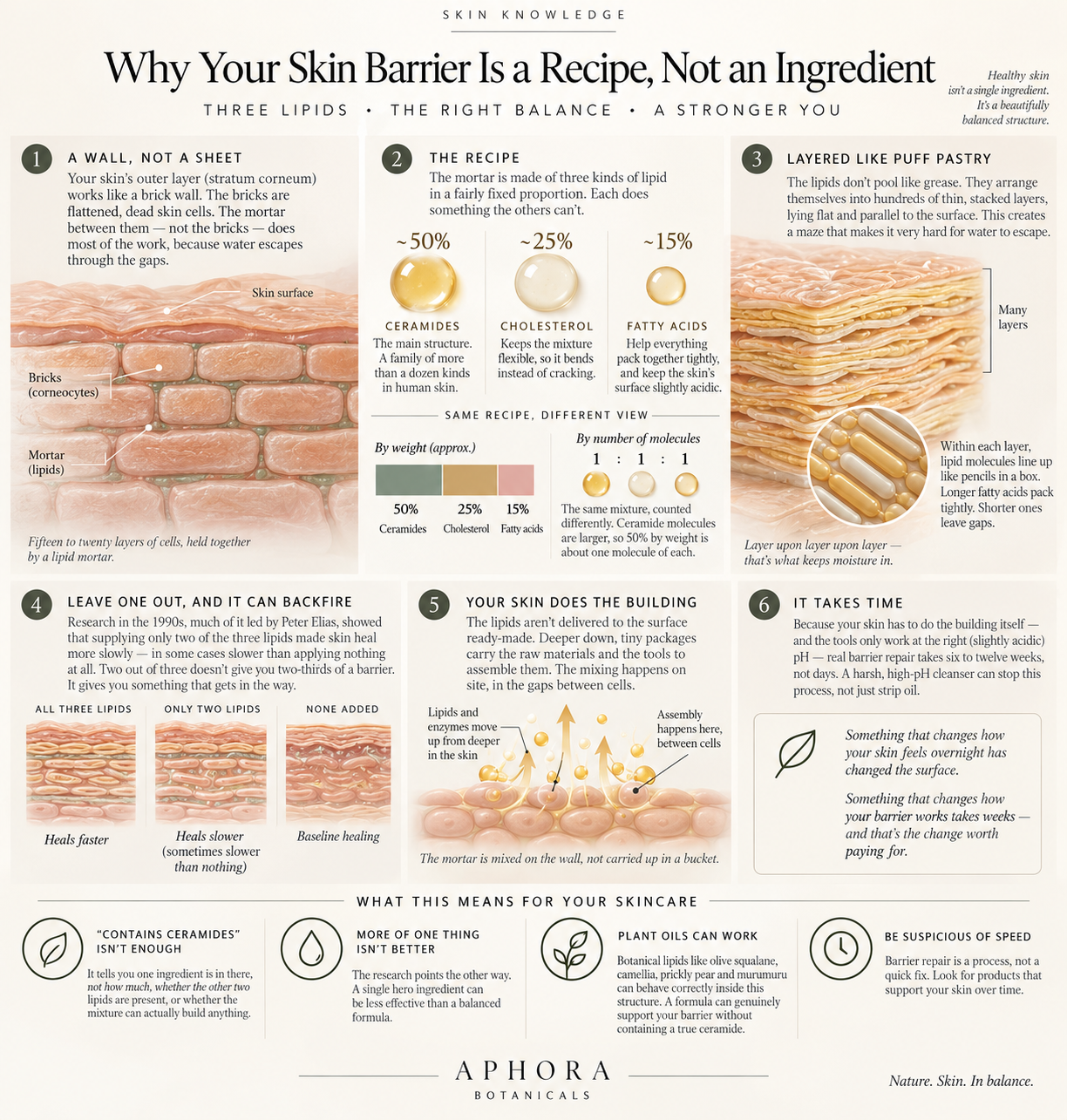
Think of the outer layer of your skin as a brick wall. The bricks are flattened dead skin cells. The mortar between them is made of three kinds of lipid — ceramides, cholesterol and fatty acids — in a fairly fixed proportion, roughly half, a quarter and fifteen per cent. Like real mortar, the proportion matters more than any one ingredient: get it wrong and the mix will not set, however good your cement. Those lipids do not simply fill the gaps like grease, either. They arrange themselves into hundreds of stacked layers, rather like puff pastry, and it is that layering that makes it so hard for water to escape. Research has found that supplying only two of the three lipids can make skin heal more slowly than applying nothing at all. Which is why a product built around one impressive-sounding ingredient is not automatically better than a balanced one — and why 'contains ceramides' tells you much less than it sounds like it does.
Key Facts
What the barrier is made of
Bricks (dead skin cells) and mortar (the skin's own lipids). The mortar does most of the work, because water escapes through the gaps
The recipe
Roughly half ceramides, a quarter cholesterol, fifteen per cent fatty acids — about one molecule of each
The surprising finding
Supplying only two of the three lipids made skin heal slower — in some cases slower than applying nothing at all
Why it holds water in
Not because lipids repel water, but because they stack in hundreds of layers and the way out is a maze
Who does the building
Your skin. It receives raw materials and assembles them on site — which is why repair takes weeks, not days
A wall, and the stuff between the bricks
Picture the outer layer of your skin as a brick wall. The bricks are flattened, dead skin cells, packed about fifteen to twenty deep. The mortar filling every gap between them is a mixture of lipids — the skin's own oils and waxes.
Most people assume the bricks do the work. They don't. Water leaving your skin, and irritants trying to get in, travel through the gaps — not through the bricks. So the mortar is what actually makes the wall watertight.
Nearly everything in this article is about the mortar, because nearly everything that goes wrong with dry, tight, reactive skin goes wrong there.
Mortar is a recipe, not an ingredient
Mortar for a real wall isn't one thing. It's cement, sand and water, mixed in proportion. Get the proportion wrong and it doesn't matter how good your cement is — the mix won't set.
Your skin's mortar works the same way. It's made of three kinds of lipid, and each does something the other two can't:
- Ceramides — about half of it. The main structure. Not one ingredient but a whole family of them, more than a dozen kinds in human skin.
- Cholesterol — about a quarter. Keeps the mixture flexible, so it bends instead of cracking.
- Fatty acids — about fifteen per cent. Help everything pack together tightly, and keep the skin's surface slightly acidic, which it needs to be.
Why you'll also see it written as 1:1:1
Those percentages are by weight. You'll often see the same recipe written as a 1:1:1 ratio, which sounds like a contradiction. It isn't — it's the same mixture counted a different way.
- Ceramide molecules are much bigger than the other two
- So half the weight works out at roughly the same number of molecules as a quarter of cholesterol
- Counted by molecule rather than by gram, it's about one of each — hence 1:1:1
What happens if you leave one out
Here is the part that most skincare gets wrong.
In the 1990s, researchers — much of the work led by Peter Elias — deliberately damaged skin barriers and then applied different lipid mixtures to see which healed fastest. You would expect any lipid to help, and more to help more.
That is not what happened. Mixtures containing all three lipids healed faster. Mixtures containing only two of the three healed slower — in some cases slower than putting nothing on at all.
Two out of three doesn't give you two-thirds of a barrier. It gives you something that gets in the way. The lipids that do arrive take up space in the structure without letting it finish, rather like half-filling a wall cavity and then trying to build properly around it.
So a product built around one impressive-sounding lipid is not automatically better than a balanced one. It might genuinely be worse — and a single hero ingredient on a front panel tells you very little about whether a product will help your barrier.
The lipids don't pool — they stack, like pastry
If those lipids simply filled the gaps like grease, the recipe would matter much less. They don't. They arrange themselves into sheets — layer upon layer upon layer, lying flat and parallel to the surface of your skin.
The closest everyday thing is puff pastry. Hundreds of paper-thin layers, stacked.
And here's the useful part of that image. What makes puff pastry hard for water to soak through isn't that butter repels water. It's that the water would have to cross layer, after layer, after layer — and the journey is simply too long to be worth making.
Your skin barrier works on exactly that principle. It doesn't hold water in because lipids repel water. It holds water in because the way out is a maze. Damage the layering and you haven't removed a substance — you've shortened the route.
How tightly it's all packed
There's one more level of order, and it's where those fatty acids earn their place.
Within each sheet, the lipid molecules line up side by side — think of pencils lying in a box. They can be packed tight and neat in rows, or loosely, with gaps between them. Tighter packing means a better barrier, and healthy skin is packed tight, especially near the surface.
What decides it is length. Long fatty acids line up neatly alongside each other. Short ones disrupt the rows and leave gaps. This is why the fatty part of the mixture can't just be any oil — the length of the molecules is doing real work.
So the barrier depends on three things stacked on top of each other: the right lipids, in the right proportion, packed at the right density. Only the first of those is a question about ingredients.
Your skin does the building
One more thing changes what any product can realistically do for you.
The lipids aren't delivered to the surface ready-made. Deeper down, tiny packages carry the raw ingredients upward — along with the tools needed to turn them into finished lipids. Both are released into the gaps between cells, and the mixing happens right there, in place.
The mortar is mixed on the wall, not carried up in a bucket.
Those tools only work if the surface of your skin is at the right acidity, which is one reason a harsh, high-pH cleanser does more damage than it seems like it should — it doesn't just strip oil, it stops the building work.
And it's the honest answer to why barrier repair takes six to twelve weeks rather than a few days. You're not filling a hole. You're delivering materials to a building site and waiting for the work to be done.
What to take to the shop with you
Four things follow from all this, and they're more useful than any ingredient list.
- “Contains ceramides” tells you one ingredient is in there. It says nothing about how much, nothing about whether the other two lipids are present, and nothing about whether the mixture can actually build anything. It's a claim about a material, not about your barrier.
- More of one thing isn't better. The research points the other way. A product built around a single hero ingredient is making a marketing decision, not a skin one.
- Plant oils can do this job without being ceramides. What the structure needs is molecules that behave correctly inside it — the right lengths, the right balance. Botanical lipids can supply that. A formula can genuinely support your barrier without containing a true ceramide, as long as it's honest about which it is.
- Be suspicious of speed. Something that changes how your skin feels overnight has changed the surface. Something that changes how your barrier works takes weeks — and that's the change worth paying for.
Aphora Botanicals
Why We Say Ceramide-Like, And Mean It
Aphora doesn't contain a true ceramide. We could add one tomorrow, print it on the front of every pack, and be doing nothing that the rest of the industry doesn't do. Instead we say ceramide-like botanical lipids — three extra words, and this article is why they're worth it.
Your barrier isn't asking for a molecule with a particular name. It's asking for three kinds of lipid, in a proportion it can build with, at the right lengths to pack together. Olive squalane, camellia, prickly pear and murumuru behave correctly inside that structure. Calling them ceramides would be untrue. Calling them nothing at all would undersell what they do.
It's also the standard we hold ourselves to everywhere else. If the barrier is a recipe rather than an ingredient, then competing on ingredient names is answering a question your skin never asked — and a claim that can't survive its own biology has no business on a label.
Comparison
| Buying by Ingredient | Buying by Recipe | |
|---|---|---|
| What the claim is about | Which lipids are in the bottle | Whether they arrive in a proportion your skin can build with |
| What the front of the pack says | "Contains ceramides" | Three kinds of lipid, in the barrier's own proportion |
| Does more help? | Assumed yes — a bigger number reads as better | Not necessarily. An unbalanced mixture can slow healing down |
| Who builds the barrier | Unsaid — you're left to assume the product does | Your skin does, using the materials and tools it's given |
| What actually decides the result | How much is in there | Proportion, molecule length, how tightly it packs, surface pH |
| How long it should take | Days — which means a change to the surface | Six to twelve weeks — which means a change to the structure |
| How you'd know it worked | By reading the label | By how your skin behaves over weeks — less tight, less reactive |
Frequently Asked Questions
Common Questions
Ceramides are the main structure — about half the mixture, and not one ingredient but a family of more than a dozen. Cholesterol, about a quarter, keeps things flexible so the structure bends rather than cracks. Fatty acids, about fifteen per cent, help everything pack together tightly and keep the skin's surface slightly acidic. You need all three. The other two can't cover for a missing one.
They're the same recipe counted two different ways. The percentages are by weight. The 1:1:1 is by number of molecules. Ceramide molecules are much bigger than the other two, so half the weight works out at roughly the same number of molecules as a quarter of cholesterol. Counted by molecule it's about one of each — hence 1:1:1. Nothing contradicts anything.
Yes, if the others are missing. When researchers applied only two of the three lipids to damaged skin, healing was slower than applying nothing at all. The lipids that arrive seem to take up space in the structure without letting it finish. Complete mixtures healed faster, even when one of the three was present in excess. So balance matters more than the concentration of any single ingredient.
Not on its own. It tells you one ingredient is present, at an amount you aren't told, with nothing said about whether the other two are there or in what proportion. Ceramides alongside a well-judged balance of other lipids may help considerably. A trace of ceramide alongside strong acids may not help at all. The ingredient isn't the claim.
They can, without being ceramides. What the structure needs is molecules that behave correctly inside it — the right lengths, the right balance of lipids and plant sterols. Botanical oils can supply that. It's why a product can genuinely support your barrier without containing a true ceramide, and why the honest way to describe it is ceramide-like rather than ceramide.
Because your skin does the building, not the product. The raw materials and the tools to assemble them are delivered together into the gaps between cells, and the work happens there. It's a biological process running at biological speed, and it depends on the surface being at the right acidity. A product supplies materials to a building site; it doesn't install a finished barrier. Six to twelve weeks is the honest answer.
The sheets are called lamellae, and they stack in two repeating patterns — a shorter one and a longer one, the long one being about thirteen nanometres and considered especially important. It depends on one unusual ceramide that carries a long fatty acid tail, which is long enough to reach across and pin neighbouring layers together. If puff pastry is the picture, that ceramide is the thing stopping the layers sliding apart.
Some studies on ceramide supplements report modest improvements in hydration, and plant-derived ones are sold on that basis. It's a completely different route, though — anything you eat is broken down and redistributed by the body rather than delivered into the gaps between skin cells. The reported effects are generally small. Worth knowing about; not a replacement for what happens on the surface.