Skin Biology
Understanding the Skin Barrier
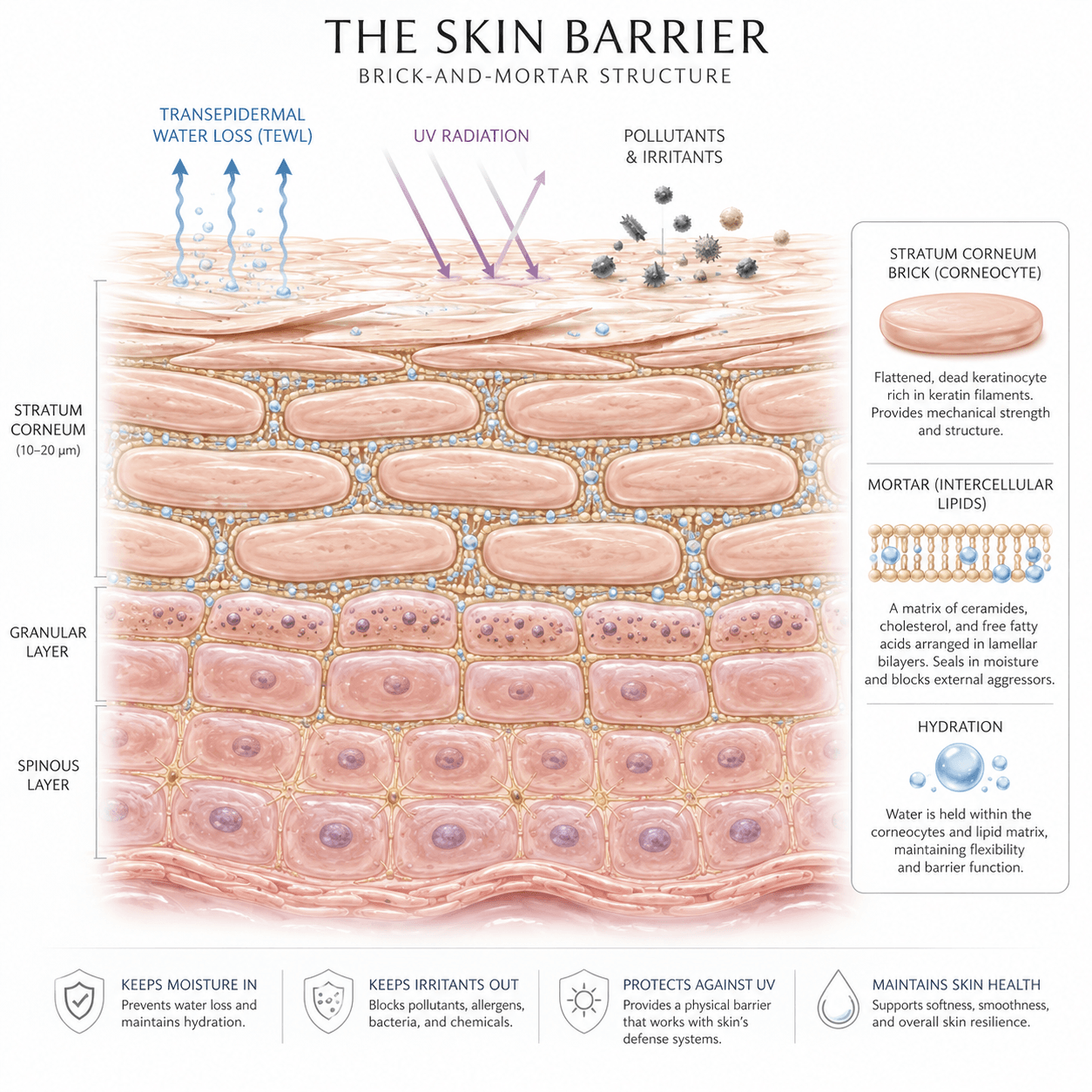
Quick Answer
The skin barrier — formally the stratum corneum — is the outermost layer of skin and the body's primary defence against moisture loss, environmental damage, and microbial intrusion. It functions through a tightly organised structure of dead skin cells embedded in a lipid matrix of ceramides, fatty acids, and cholesterol. When intact, skin remains hydrated, resilient, and calm. When compromised, it becomes reactive, chronically dehydrated, and vulnerable to conditions including rosacea, eczema, and accelerated visible ageing.
Key Facts
Architecture
Corneocytes (the 'bricks') embedded in a lipid matrix of ceramides, fatty acids, and cholesterol (the 'mortar')
Lipid ratio
Ceramides ~50%, cholesterol ~25%, free fatty acids ~15% — disruption of this ratio compromises barrier integrity
TEWL
Transepidermal water loss (TEWL) is the primary clinical measure of barrier integrity — higher TEWL indicates greater compromise
Skin renewal
The stratum corneum renews itself approximately every 28 days; meaningful barrier repair follows this cycle
Aphora Botanicals
Every Aphora formula is designed to support the skin barrier — delivering barrier-compatible lipids without the surfactants or synthetic fragrances that compromise it
The architecture of the skin barrier
The skin is organised in layers. The outermost — the stratum corneum — is the result of a continuous process of cellular differentiation. Living keratinocytes in the deeper epidermis migrate toward the surface, gradually losing their cellular machinery, flattening, filling with structural proteins, and finally dying to become corneocytes: the tough, protein-rich cells that form the surface of the skin.
These corneocytes are the bricks. Between them sits the mortar: a precisely organised lipid matrix composed primarily of ceramides, cholesterol, and free fatty acids. This is not a passive filler. The lipids are arranged into bilayer structures — alternating water-attracting and water-repelling layers — that create an architecture specifically designed to resist both moisture loss from within and environmental penetration from without.
The ratio of lipids within this matrix matters as much as their presence. Ceramides account for approximately 50% of the lipid content, cholesterol approximately 25%, and free fatty acids approximately 15%. Disruption to this ratio — through disease, aggressive skincare, environmental damage, or natural ageing — compromises the structural integrity of the entire barrier, often before any visible signs appear.
The Natural Moisturising Factor
Within the corneocytes themselves sits another critical component of barrier function: the Natural Moisturising Factor, or NMF. NMF is a mixture of water-soluble compounds — amino acids, urocanic acid, lactic acid, and pyrrolidone carboxylic acid (PCA) among others — produced as a byproduct of the breakdown of the structural protein filaggrin.
NMF acts as a humectant within the skin cell itself, drawing water from the deeper layers of the epidermis and from the atmosphere into the stratum corneum. It keeps the corneocytes pliable, maintains the cohesion of the surrounding lipid matrix, and is responsible for much of what we perceive as skin softness and suppleness at the surface.
Reductions in NMF — associated with ageing, UV exposure, low-humidity environments, and harsh cleansing — are a primary cause of the chronic skin dryness that does not resolve with standard topical humectants. Addressing barrier dehydration requires supporting NMF, not simply applying water.
How the skin barrier becomes compromised
Barrier compromise occurs when the lipid matrix is disrupted, when NMF is depleted, or when the structural turnover of the stratum corneum is dysregulated. The causes are numerous and frequently compound one another:
- Harsh surfactants (SLS, SLES) — strip the lipid matrix directly with each cleanse
- Synthetic fragrance — triggers immune-inflammatory responses within barrier cells, degrading lipid organisation over time
- Over-exfoliation — removes corneocytes faster than the skin can replace them, thinning the barrier
- Low humidity environments — accelerate TEWL and deplete NMF progressively
- UV exposure — degrades ceramide synthesis and causes oxidative damage to barrier lipids
- Aggressive active ingredients — high-concentration acids, strong retinoids, and solvent-heavy formulas can disrupt barrier integrity if introduced too quickly
- Chronic inflammatory conditions — rosacea, eczema, and psoriasis are both causes and consequences of barrier disruption, sustaining a cycle that worsens without targeted intervention
- Natural ageing — ceramide synthesis declines measurably from the 30s, accelerating after menopause
The consequences of a compromised barrier
A compromised skin barrier does not simply feel dry. The effects propagate through the skin's entire biological environment:
- Elevated TEWL — moisture escapes continuously; hydration cannot be maintained by surface application alone
- Heightened reactivity — products previously tolerated become irritating; the skin responds to environmental stimuli it would normally filter
- Deeper inflammatory penetration — triggers that would be blocked at an intact surface penetrate into the dermis, activating more significant immune responses
- Chronic redness — barrier-compromised vasculature is more easily stimulated, worsening conditions such as rosacea
- Accelerated visible ageing — chronic TEWL and inflammation degrade collagen and elastin more rapidly, producing fine lines and loss of firmness
- Microbiome disruption — altered surface pH and lipid composition disturbs the beneficial microbial communities that support barrier integrity
What the skin barrier needs to repair
Barrier repair is a biological process, not a cosmetic one. It cannot be rushed beyond the skin's own renewal cycle — but it can be supported, and it can be obstructed. The conditions for effective repair are straightforward:
Replenish barrier lipids
The lipid matrix requires the right fatty acids and sterols to rebuild:
- Linoleic acid (omega-6) — often deficient in compromised barrier skin; found in rosehip, sea buckthorn, and evening primrose oils
- Phytosterols — plant-derived sterols that occupy the same structural role as cholesterol in the lipid bilayer
- Ceramide-like botanical lipids — skin-compatible plant oils that integrate into the barrier architecture
Reduce TEWL while repair occurs
An occlusive layer prevents moisture from escaping during the repair window:
- Lightweight botanical face oils — provide an occlusive layer without congesting pores
- Barrier-supportive face creams — reinforce the aqueous component of the barrier alongside the lipid phase
Interrupt the inflammation cycle
Chronic inflammation prevents repair — it must be reduced alongside barrier restoration:
- Anti-inflammatory carotenoids and polyphenols from botanical oils and extracts
- Bisabolol and related compounds from chamomile — reduce cytokine activity in skin tissue
- Elimination of synthetic fragrance, harsh surfactants, and known irritants
Stop ongoing compromise
The barrier cannot repair if it is being continuously challenged:
- Switch to gentle, low-surfactant or surfactant-free cleansing
- Remove synthetic fragrance from all steps of the routine
- Pause aggressive exfoliating actives until the barrier has stabilised
Aphora Botanicals
Aphora Botanicals: Built Around Barrier Integrity
At Aphora Botanicals, barrier integrity is not a feature of our formulations — it is the premise of them. Every product we make is designed to work with the skin's biological architecture rather than override it. This means no harsh surfactants, no synthetic fragrance, no conventional preservatives that sensitise barrier cells, and no actives delivered at concentrations that compromise the very structure they are meant to improve.
TERRA GLOW Recovery Night Face Oil delivers a concentration of barrier-supporting botanical lipids during the overnight window when the skin's own repair processes are most active — when cellular turnover accelerates and the lipid matrix has the best conditions for regeneration. TERRA GLOW Protect Day Face Oil equips the barrier with the phytosterols and anti-inflammatory bioactives it needs to withstand the cumulative demands of UV, environmental stress, and temperature variation throughout the day.
TERRA Lumé Deep Hydration Face Cream works alongside both oils to reinforce the aqueous dimension of the barrier — providing the hydration depth that the lipid phase requires to function effectively. These three formulas are designed to be used together as a complete barrier system: morning, evening, and over time.
Healthy skin is not complicated skin. A barrier that is intact, well-nourished, and free from chronic inflammation needs very little else. Our work is to get it there — and then stay out of its way. Made for those who recognise the difference.
Comparison
| Compromised Skin Barrier | Intact Skin Barrier | |
|---|---|---|
| Hydration | TEWL elevated; skin feels dry regardless of moisturiser applied | Moisture retained effectively; TEWL remains low |
| Reactivity | Reactive to previously tolerated products and environments | Tolerant; external triggers filtered at the surface |
| Inflammation | Elevated; triggers penetrate and activate deeper immune responses | Controlled; surface immune responses proportionate and resolved quickly |
| Redness | Persistent or intermittent; capillaries chronically stimulated | Even tone; vascular response normalised |
| Texture | Rough, tight, or flaky; NMF depleted and corneocytes poorly hydrated | Smooth, supple; NMF intact and lipid matrix organised |
| Recovery | Slow to recover after environmental or product challenge | Repairs quickly; renewal cycle unimpeded |
Frequently Asked Questions
Common Questions
The skin barrier — the stratum corneum — is composed of two elements working together. Corneocytes are flattened, protein-filled dead skin cells that provide structural rigidity. Between them sits the lipid matrix: a precisely organised mixture of ceramides (approximately 50%), cholesterol (approximately 25%), and free fatty acids (approximately 15%). Within the corneocytes themselves, the Natural Moisturising Factor (NMF) — a mixture of amino acids, lactic acid, and other humectants — maintains cellular hydration and keeps the overall structure flexible and intact.
The most common signs of barrier compromise are persistent dryness that does not respond to moisturiser, increased skin reactivity to products previously tolerated, stinging or burning when applying water-based skincare, a tight sensation after cleansing, and persistent or intermittent redness. In more significant compromise, skin may become flaky, rough-textured, or prone to breakouts as the microbiome is disrupted. These symptoms often appear gradually and are frequently attributed to individual product sensitivities rather than recognised as systemic barrier dysfunction.
Meaningful barrier repair typically requires a minimum of 28 to 56 days of consistent, supportive skincare — aligned with the skin's own renewal cycle of approximately 28 days. Initial improvements in reactivity and comfort may be noticeable within one to two weeks of eliminating trigger ingredients and introducing barrier-supportive lipids. Full structural restoration — measurable as reduced TEWL and stabilised inflammatory response — is a longer arc, and in cases of chronic disruption may take three to six months of consistent practice.
The most effective barrier-supporting ingredients are those that replenish the lipid matrix and reduce the inflammatory cycle simultaneously. Linoleic acid-rich botanical oils (rosehip, sea buckthorn, evening primrose) address the fatty acid deficiency common in compromised skin. Phytosterols from plant oils provide the structural equivalent of cholesterol in the lipid bilayer. Anti-inflammatory botanicals — including carotenoids, bisabolol, and polyphenols — interrupt the inflammation that perpetuates barrier disruption. Equally important is what to remove: synthetic fragrance, harsh surfactants, and aggressive exfoliating actives all obstruct repair.
Yes, significantly. Ceramide synthesis declines measurably from the early 30s and accelerates after menopause, progressively reducing the density and organisation of the lipid matrix. Filaggrin production also decreases with age, reducing NMF levels and the skin's capacity to retain moisture within the stratum corneum. The skin's renewal cycle slows from approximately 28 days in younger adults to 45 to 60 days in older skin, meaning barrier compromise takes longer to resolve naturally. These changes make consistent, lipid-focused skincare increasingly important as a proactive rather than reactive practice.