Clean Beauty & Formulation
Refrigerated Skincare: The Future of Truly Clean Beauty
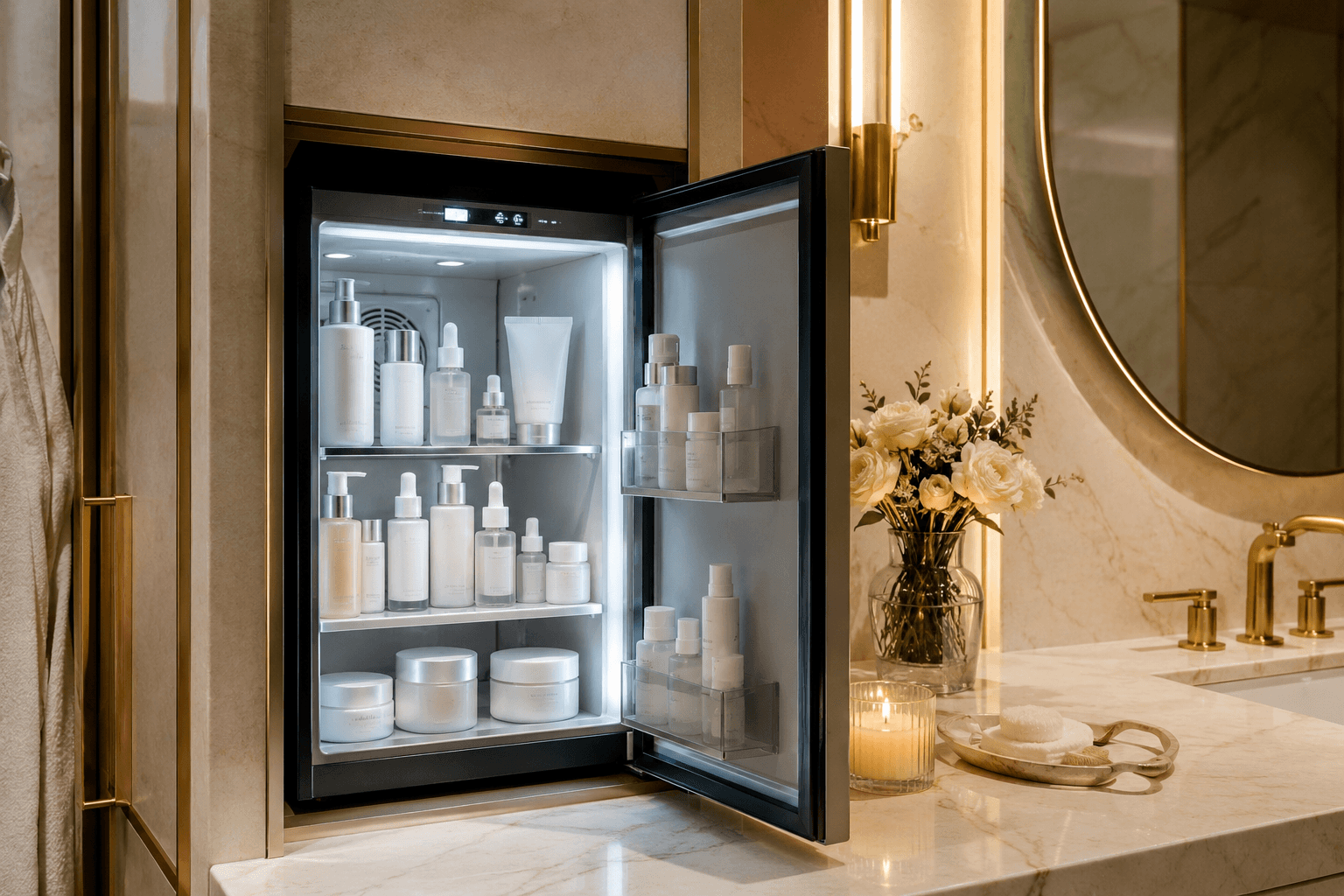
Quick Answer
Truly clean beauty has always faced a paradox: the more synthetic preservation is reduced, the harder it becomes to maintain a safe, stable formula at room temperature across 24 to 36 months of ambient shelf life. Refrigerated skincare resolves this tension. When formulas are designed for cool storage, gentler COSMOS-approved preservation systems become not just viable but ideal — allowing brands to deliver maximum botanical potency without the preservation compromises that conventional retail demands. Refrigeration is not a trend. It is where honest clean formulation leads.
Key Facts
Temperature rule
For every 10°C rise in temperature, the rate of chemical degradation in a formula approximately doubles (the Q10 principle)
Optimal beauty fridge range
7°C to 12°C — cool enough to slow degradation, without causing emulsion separation
Spa origins
Refrigerated product application has been standard in professional skincare treatments for decades
Preservation benefit
Cool storage slows microbial activity, reducing the demands placed on a preservation system
Aphora Botanicals
Aphora designs select formulas for refrigerated storage — a deliberate expression of genuine clean formulation, not a logistics compromise
The paradox at the heart of clean beauty
For years, the clean beauty movement has made a promise it has struggled to keep: remove synthetic ingredients, and what you are left with is something better. The reality of formulation science is more complicated. Most water-containing skincare products — however naturally positioned — still require a functioning preservation system to remain safe across the shelf lives that retail demands. The cleaner the preservation philosophy, the harder that becomes at room temperature over 24 to 36 months.
Refrigerated skincare is where this tension resolves. By designing formulas for cool storage rather than ambient shelf stability, brands can work with gentler, certified-natural preservation systems, protect the full potency of heat-sensitive botanical actives, and offer something that is genuinely clean — not just clean in its marketing language.
Why temperature affects skincare efficacy
Heat accelerates chemical reactions within a formula. For active ingredients, this means the oxidative and degradation processes that reduce efficacy over time occur faster at higher temperatures. In cosmetic chemistry, this is described by the Q10 principle: for every 10°C rise in temperature, the rate of chemical degradation approximately doubles.
This is not a marginal effect. A product stored in a warm bathroom at 28°C will lose active ingredient potency significantly faster than the same product stored at 8°C — often within the same usage window.
- L-ascorbic acid (Vitamin C) — oxidises rapidly above 20°C, converting to inactive dehydroascorbic acid
- Retinoids and bakuchiol — photosensitive and heat-sensitive; efficacy diminishes with repeated temperature exposure
- Peptides — susceptible to structural degradation at elevated temperatures, reducing receptor binding activity
- Fermented botanical extracts — contain active bioferment compounds that degrade with heat
- Probiotic and postbiotic actives — particularly temperature-sensitive; cool storage is essential for maintaining activity
- Unstabilised plant oils — prone to oxidative rancidity when exposed to fluctuating temperatures
How cool storage unlocks genuinely clean preservation
Microbial growth — the primary target of cosmetic preservation systems — slows significantly at temperatures below 10°C. For water-containing formulas, this means cool storage materially reduces the demands placed on a preservation system. The formula does not need to fight contamination as hard, because the environment does not favour microbial activity.
This creates a fundamental design opportunity: COSMOS and Ecocert-approved preservation systems — considered too gentle for the demands of ambient 24 to 36-month shelf life — become genuinely viable when cool storage is part of the product's intended use. The result is formulas that are clean in a structural sense, not just a labelling one. Ingredient integrity and preservation gentleness stop competing with each other.
This is what separates refrigerated clean beauty from aspirational clean beauty. The former resolves the paradox. The latter papers over it.
Why the clean beauty consumer is ready for this shift
The consumer driving the clean beauty category has become considerably more sophisticated. Ingredient literacy is rising, greenwashing fatigue is real, and the questions being asked — about preservation systems, shelf-life trade-offs, supply chain transparency — are the same questions that refrigerated formulation answers directly.
The beauty fridge has moved from novelty to considered purchase. Several credible independent brands now recommend cool storage as part of their product care guidance. The signals are converging:
- Ingredient transparency — brands that explain why refrigeration helps are perceived as formulation-honest rather than marketing-led
- Spa and professional heritage — refrigerated product application has been standard in high-end professional skincare treatments for decades; home refrigeration connects to that lineage
- Fresh skincare connotations — shorter shelf life, lighter preservation, and cool storage signal a different relationship with time and integrity
- Fresh-batch alignment — refrigeration implies direct distribution, fresher production, and a supply chain not built around warehouse longevity
The ritual dimension: why cool application matters beyond science
Beyond ingredient science, cool application has documented physiological effects. Applying a cold product to the face causes temporary vasoconstriction — the narrowing of surface blood vessels — which reduces visible redness and puffiness. Eye treatments and facial serums applied cold are particularly associated with morning depuffing practices in professional skin care.
But there is a dimension beyond physiology. For consumers who have moved past performative clean beauty — who want to understand what is actually in their products and why — the cool-storage ritual is a physical expression of that values alignment. The act of keeping a serum away from heat, taking it deliberately from a cool space, feeling the temperature at the moment of application — these are not inconveniences. They are signals that the formula has been designed with real intent, not extended shelf life.
Aphora Botanicals
Aphora Botanicals: Formulated for a Different Standard
At Aphora Botanicals, refrigerated storage is not a concession — it is a position. Our fresh-batch, direct-distribution model means products arrive within weeks of production. Designing for cool storage allows us to work exclusively with COSMOS and Ecocert-approved preservation systems at their most effective, without compromise to the botanical actives they protect. This is what clean formulation looks like when the supply chain actually supports it.
In select formulas — including our TERRA Lumé Deep Hydration Face Cream — we work with nature's most delicate bioactives, compounds whose structural integrity and full efficacy are best preserved in cool conditions. For these formulas, refrigeration is not an afterthought. It is woven into the product's design from the beginning.
At Aphora, we have come to regard the cool-storage ritual as one of the quiet pleasures of considered skincare. The moment of reaching for a serum kept cool, the temperature against skin at application, the signal it sends that something intentional is happening — these details matter. This is not shelf-stable skincare engineered for a warehouse. Aphora exists in a different category entirely, made for those who recognise the difference.
Comparison
| Room-Temperature Skincare | Refrigerated Skincare | |
|---|---|---|
| Preservation load | Higher — designed for ambient stability over 24–36 months | Lower — cool storage reduces microbial demand on the preservation system |
| Active ingredient stability | Dependent on formula engineering and packaging | Extended by consistently cool storage conditions |
| Shelf life target | 24–36 months unopened | 6–18 months, often shorter by design |
| Supply chain model | Mass retail, warehoused, long distribution timelines | Direct, fresh-batch, shorter time from production to use |
| Sensorial experience | Ambient temperature application | Cool, vasoconstricting, elevated sensory moment |
| Clean beauty credibility | Often aspirational — preservation may still be synthetic | Structural — preservation is genuinely minimal by design |
Frequently Asked Questions
Common Questions
No adequately preserved skincare product requires refrigeration to be safe. However, refrigeration can meaningfully extend the efficacy period of certain active ingredients, allow brands to formulate with gentler preservation systems, and provide a superior sensorial experience at the moment of application. Whether a product benefits from refrigeration depends on its active ingredient profile, preservation philosophy, and intended shelf life — not on safety alone.
Vitamin C (L-ascorbic acid) is among the most temperature-sensitive skincare actives, oxidising rapidly at elevated temperatures. Peptides, fermented botanical extracts, retinoids, bakuchiol, probiotic and postbiotic actives, and unstabilised plant oils also degrade faster with heat exposure. Products built around these ingredients typically benefit from consistent cool, dark storage conditions throughout their use period.
A dedicated beauty fridge is typically set between 7°C and 12°C. This range is cool enough to slow active ingredient degradation and reduce microbial activity, without being so cold that emulsions separate, gels change texture, or oils solidify. Standard household refrigerators (around 4°C) can work for most formulas, but some emulsions may be sensitive to temperatures below 5°C.
No. Refrigeration reduces microbial growth but does not eliminate the need for preservation in water-containing formulas. It is best understood as a complementary strategy: cool storage reduces the demands placed on a preservation system, allowing brands to use gentler, lighter systems — rather than removing preservation entirely. Anhydrous formulas containing no water are a separate case; they may require no preservation regardless of storage temperature.
There is a strong argument that it is — at least for serious clean formulation. The core challenge of clean beauty has always been that reducing synthetic preservation makes ambient shelf stability harder to maintain. Refrigeration resolves this by reducing the microbial demands on a preservation system, making genuinely gentle, certified-natural preservation viable across a product's full shelf life. Brands willing to redesign their supply chain around direct, fresh-batch distribution are increasingly arriving at refrigerated formulation as the honest endpoint of a clean philosophy.