Menopause & Skin
The 3 R's of Menopausal Skin
Quick Answer
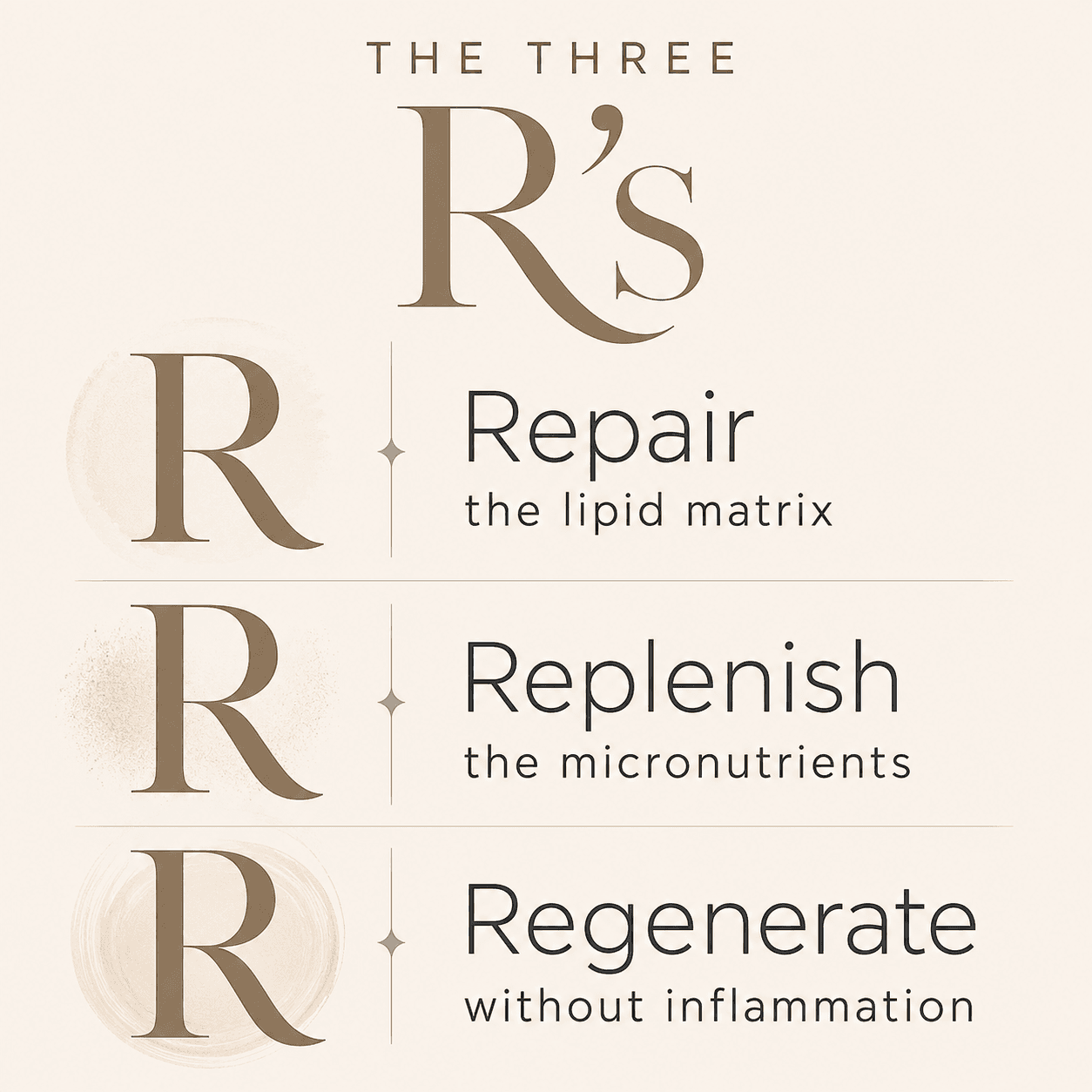
Peri, meno, and post-menopause change the skin's biology in ways skincare vocabulary rarely names honestly. Estrogen decline thins the stratum corneum, depletes barrier lipids, shifts the microbiome, and slows the entire repair cycle. Corneotherapy — the evidence-based skincare methodology founded by Professor Albert M. Kligman — organises the response into three continuous actions: Repair the lipid matrix, Replenish the micronutrients, Regenerate without inflammation. Applied to menopausal skin specifically, each R takes on a distinct shape. This is where the biology and the methodology meet.
Key Facts
Collagen loss, first 5 years post-menopause
Approximately 30% of dermal collagen (Brincat et al.); ~2% annual decline thereafter
Skin thinning rate
Approximately 1.13% per year of skin thickness lost after menopause
R1 — Repair hero
TERRA Lumé Deep Hydration Face Cream — refrigerated, lipid-architected for the 1:1:1 ratio
R2 — Replenish hero
TERRA GLOW Protect Day Face Oil — antioxidants beneath (never in place of) SPF, which is now non-negotiable
R3 — Regenerate hero
TERRA GLOW Recovery Night Face Oil — bakuchiol and Boswellia sacra CO2, chosen over retinol for a barrier already in flux
Honest timeline
6 to 12 weeks for barrier reorganisation; visible skin autonomy in months, not days
What the skin is actually doing in perimenopause, menopause, and post-menopause
The skincare industry describes this chapter with a single word — mature — that flattens three distinct biological phases into one aesthetic bucket. The biology does not flatten. Each phase presents differently, and the skin responds to different things.
Perimenopause typically begins in the mid-40s and lasts 4 to 10 years. Estrogen does not decline gradually; it fluctuates chaotically. The skin becomes unpredictable — adult acne can return, reactivity rises, redness patterns shift, and the earliest measurable slowdown in collagen synthesis begins.
Menopause is defined clinically as 12 consecutive months without a period; the average age is 51. Estrogen drops sharply, and this is the most rapid phase of skin change: barrier repair slows, sebum production drops, the microbiome shifts, and skin that felt reliable for decades begins to behave differently within a season.
Post-menopause is where the trajectory settles into a longer curve. The most-cited figure is from Brincat and colleagues: approximately 30% of dermal collagen is lost in the first 5 years post-menopause, followed by a slower decline of around 2% per year. Skin thickness reduces at approximately 1.13% per year over the same period.
Why menopausal skin needs a methodology, not an anti-
The skin in this chapter has a lower reserve of everything the barrier depends on. Ceramide content drops. The lamellar sheets in the stratum corneum become less well-organised. Transepidermal water loss (TEWL) rises. The microbiome shifts, with youth-associated species declining and environmental species increasing — a pattern correlated with pollution exposure and the deepening of dynamic lines.
In that context, the aggressive vocabulary that dominates skincare for older women — aggressive peels, high-strength retinoids, resurfacing at pace — is asking a barrier that has already lost reserve to accept more disruption in return for visible results. The corneotherapy alternative, explored in full in our companion article on what barrier-first actually means, does the opposite. It removes chronic stressors, restores the lipid architecture, and lets the skin find its own pace of regeneration.
Organised into three continuous actions — Repair, Replenish, Regenerate — this is the framework applied to menopausal skin specifically.
R1 — Repair: rebuilding the lipid matrix at the 1:1:1 ratio
The first R is where menopausal skin gains most, because it is where menopausal skin has lost most. Estrogen loss drops ceramide production, slows lamellar body secretion, and disorganises the intercellular lipid sheets that regulate hydration and permeability. The skin that used to hold moisture between applications does not hold it any more. Tightness by afternoon is not sensitivity — it is elevated TEWL.
Repair means restoring the intercellular lipid matrix at the 1:1:1 molar ratio of ceramides, cholesterol, and free fatty acids — the exact ratio the stratum corneum uses to build its lamellar structure. Mixtures at the correct ratio accelerate recovery. Mixtures at the wrong ratio, even when they contain all three classes, can delay it. Ceramide-like botanical lipids matter more now than at any earlier stage of skin life.
TERRA Lumé Deep Hydration Face Cream is the R1 hero in the Aphora range. Refrigerated by design, it is composed around a lipid architecture that mirrors the skin's own — a ceramide-like botanical lipid complex (olive-derived squalane, camellia oil, prickly pear seed oil, murumuru butter) alongside cholesterol precursors and long-chain fatty acids, delivered in a fresh-batch, cool-storage format that protects the fragile bioactives that make the repair possible. This is not a moisture cream. It is a lamellar-reorganisation cream that also happens to feel like one of the most luxurious you have used.
R2 — Replenish: the botanical nutrients menopausal skin needs
Repair rebuilds the architecture. Replenish keeps the systems inside it working. In menopausal skin — where sebum has dropped, pigment has become more reactive, and antioxidant reserves are lower than at any earlier stage — three botanical replenishing actions matter most:
Botanical brighteners and licorice-derived actives
Estrogen decline unsettles the skin's pigment regulation. Sun spots that used to fade quickly now linger. Redness patterns shift. Botanical brighteners — licorice-derived actives (glabridin, licochalcone A) alongside complementary plant polyphenols — promote a more even-looking complexion by working at the pigment-regulation step upstream of visible tone, without the barrier stress that hydroquinone-family interventions demand.
- Licorice extracts are among the most-studied botanical brighteners for gentle, cumulative tone-evening
- The action is slow — 6 to 12 weeks to visible change — but the pattern of use is one the barrier tolerates indefinitely
- Best used consistently at low daily concentration rather than in aggressive short peaks — that is what the mechanism actually rewards
Beta-glucan, ectoin, tremella, aloe, and hyaluronic acid
As sebum drops and the barrier's water-holding reserve reduces, the skin needs more help binding and retaining moisture. Beta-glucan (from oat), ectoin (a small osmoprotectant molecule), tremella polysaccharide (snow mushroom), aloe polysaccharides, and hyaluronic acid form a botanical humectant portfolio that supports hydration, comfort, and barrier recovery.
- Tremella polysaccharide is one of the most-studied plant humectants for the post-cleansing tightness that becomes common in this chapter
- Ectoin protects skin cells against osmotic stress and helps the barrier retain function under environmental strain
- Beta-glucan reduces subclinical inflammation without any of the disruption of a strong anti-inflammatory active
Plant-derived antioxidants beneath SPF — which is now non-negotiable
In perimenopause and beyond, cumulative UV exposure has more consequence than at any earlier stage, because the skin's own antioxidant reserves have less to draw on. Plant-derived polyphenols, tocopherols, and carotenoids do not replace sun protection; they extend it. And SPF, at this stage of life, is not optional.
- Polyphenols, tocopherols, and carotenoids from plant lipids intercept the free radicals UV generates below the barrier
- Applied beneath (not in place of) SPF, they extend the working life of the sunscreen and reduce photoaging load
- A daytime oil designed around botanical antioxidant density is one of the single highest-return decisions in a menopausal routine
R2 in practice — TERRA GLOW Protect Day Face Oil
TERRA GLOW Protect Day Face Oil is the R2 hero. Composed for the demands of skin in daylight hours — environmental oxidative load, UV exposure, temperature variation — it delivers a dense antioxidant profile (carotenoid-rich sea buckthorn, tocopherol-rich rosehip, polyphenolic botanicals) in an anhydrous format that keeps the bioactives structurally intact until the moment of application.
The point is not to replace an SPF. The point is to sit beneath it and extend its work, while feeding the skin the micronutrients its own defence system is running on. In the menopausal chapter, this is quiet work with substantial cumulative return.
R3 — Regenerate: turnover without triggering inflammation
The third R is where most skincare aimed at this age group gets the biology wrong. The instinct — turnover has slowed, so accelerate it — is right in direction and wrong in method. Cellular turnover in menopausal skin does slow, and it can be usefully supported. But the aggressive retinoic acid, high-strength AHA, and peel-based approaches that would push turnover in younger skin are asking a compromised barrier to accept damage that its lipid reserves cannot readily repair.
The corneotherapy answer is bakuchiol. Bakuchiol is a plant-derived meroterpene (from Psoralea corylifolia) with demonstrated retinoid-like signalling activity — collagen synthesis support, dermal remodelling, evening of pigment — without the barrier-disrupting inflammatory cascade of retinoic acid. On a barrier that is already in flux, this trade-off is the one that lets regeneration proceed without setting the system back.
Frankincense is the other thing working here — Boswellia sacra, the sacred frankincense, extracted with pressurised CO2 rather than steam.
That difference matters more than it sounds. Steam distillation is hot, and heat destroys part of what the resin holds. CO2 extraction runs far cooler, so more of the plant comes through intact — including heavier compounds that steam leaves behind altogether. Close to half of what arrives is alpha-pinene, an antioxidant.
Its job in R3 is not to speed anything up. It is to keep skin comfortable while the slower work goes on, without the stripping or resurfacing that would set a fragile barrier back.
R3 in practice — TERRA GLOW Recovery Night Face Oil
TERRA GLOW Recovery Night Face Oil is the R3 hero. Formulated around bakuchiol and Boswellia sacra CO2 in an anhydrous carrier of ceramide-like botanical lipids, it works with the skin's overnight repair cycle — which, in the menopausal chapter, is when most of the useful regenerative work happens.
The pattern of use is deliberately slow. Nightly, over 6 to 12 weeks, the barrier reorganises, the skin settles, and the fine remodelling that bakuchiol supports begins to show. This is regeneration on the skin's terms — not on a marketing calendar.
How the three R's sit together across a day
The R's are not three separate routines. They are three continuous actions the skin is asking for, distributed across morning and evening according to which is most useful when.
Morning
- TERRA GLOW Rose Bloom & Balance Cleansing Face Oil for a gentle, low-surfactant cleanse — or a water-only rinse if the skin is quiet
- TERRA GLOW Protect Day Face Oil (R2 — antioxidant replenishment against daytime oxidative load)
- TERRA Lumé Deep Hydration Face Cream (R1 — lipid architecture for the day's TEWL demand)
- Mineral SPF — the non-negotiable in this chapter
- Optional: TERRA GLOW Eye + Temple Contour for the fine periorbital skin where TEWL runs highest
Evening
- TERRA GLOW Rose Bloom & Balance Cleansing Face Oil — an oil-to-milk cleanse that lifts SPF and the day's film without disturbing the acid mantle. Double-cleanse if SPF was worn.
- TERRA GLOW Recovery Night Face Oil (R3 — bakuchiol and Boswellia sacra CO2, working with the overnight repair cycle)
- TERRA Lumé Deep Hydration Face Cream over the top for R1 lamellar work as the skin repairs
Aphora Botanicals
Composed for This Chapter, Not Against It
The TERRA range is built explicitly for menopausal skin — perimenopausal, menopausal, and post-menopausal — and the vocabulary Aphora uses reflects the position. We do not speak of anti-anything, because we are not trying to fight a biology that is doing what biologies do. We are trying to support it. The distinction is more than linguistic, and it is explored in full in our companion article on why we don't use the word anti-aging.
TERRA Lumé Deep Hydration Face Cream is the R1 hero: refrigerated, lipid-architected, composed around the 1:1:1 ratio the stratum corneum uses to rebuild itself. TERRA GLOW Protect Day Face Oil is the R2 hero: an antioxidant-dense daytime oil that sits beneath SPF and extends its work. TERRA GLOW Recovery Night Face Oil is the R3 hero: bakuchiol and Boswellia sacra CO2, chosen over retinol precisely because the barrier in this chapter cannot afford the disruption that comes with retinoid resurfacing.
The three together are the corneotherapy answer to what estrogen decline actually does to skin — quiet, unhurried, and composed for the skin, not the shelf.
Comparison
| The Conventional 'Anti-Ageing' Approach | The 3 R's Approach for Menopausal Skin | |
|---|---|---|
| Framing | Fight ageing, reverse decline, restore youthful skin | Support the skin's biology in this chapter — Repair, Replenish, Regenerate |
| Signature actives | High-strength retinoids, high-percentage AHAs, peels, aggressive resurfacing | Ceramide-like botanical lipids at the 1:1:1 ratio, licorice-derived brighteners, tremella and beta-glucan, plant polyphenols and tocopherols, bakuchiol, Boswellia sacra CO2 |
| Attitude to the barrier | Barrier disruption accepted as a cost of visible results | Barrier treated as the site of all meaningful work; TEWL as the direction of travel |
| Attitude to the microbiome | Rarely considered; harsh cleansers common | Actively protected; acid mantle and microbial diversity preserved by design |
| How results look week to week | Visible flaking, redness, and peeling as evidence of 'working' | Reactivity reducing, hydration sustaining, calm emerging quietly |
| Timeline claimed | 7 to 14 days | 6 to 12 weeks for lamellar reorganisation; months for visible autonomy |
| What the skin is being asked to do | Accept damage in exchange for renewal | Find its own pace, without the chronic barrier stress |
Frequently Asked Questions
Common Questions
It starts in perimenopause — typically in the mid-40s, sometimes earlier — when estrogen begins fluctuating chaotically rather than declining smoothly. The visible signals are inconsistency: adult acne returning, reactivity rising, redness patterns shifting, hydration that felt reliable no longer holding. Menopause itself (defined as 12 consecutive months without a period, average age 51) is the sharpest transition: estrogen drops steeply, ceramide production drops with it, and the barrier's reserve reduces measurably. Post-menopause is the longer settling curve — approximately 30% of dermal collagen is lost in the first 5 years, then a slower ~2% annual decline.
The 3 R's are the framework used in corneotherapy to organise skincare around the biology of the stratum corneum. Repair — restore the intercellular lipid matrix at the 1:1:1 ratio of ceramides, cholesterol, and free fatty acids. Replenish — deliver the essential micronutrients (niacinamide, panthenol, antioxidants) the skin needs to sustain its own defences. Regenerate — encourage cellular turnover without triggering inflammation, using gentler regenerative signals such as bakuchiol rather than retinoic acid on a compromised barrier.
The 1:1:1 molar ratio of ceramides, cholesterol, and free fatty acids is the ratio the stratum corneum itself uses to assemble its lamellar sheets — the stacked lipid structures that regulate transepidermal water loss and permeability. Topical mixtures applied at the correct ratio accelerate barrier recovery. Mixtures at the wrong ratio, even when they contain all three lipid classes, can delay recovery by disrupting lamellar organisation. In menopausal skin, where ceramide production has already dropped, the ratio matters more than at any earlier stage.
Retinoic acid is a well-studied active with significant clinical evidence for photoaging, but the trade-off it makes is barrier disruption in exchange for regenerative signalling. In earlier skin life, that trade-off is often acceptable. In menopausal skin — where the barrier's lipid reserve has already dropped, ceramide production has slowed, and TEWL is already elevated — the same disruption is more costly to recover from. Bakuchiol is a plant-derived meroterpene with retinoid-like signalling activity (collagen synthesis support, dermal remodelling, pigment evening) but without the same inflammatory cascade. On a barrier already in flux, it lets regeneration proceed without setting the system back.
Yes, and more so than at any earlier stage. Cumulative UV exposure interacts with the reduced antioxidant reserve, thinner stratum corneum, and slower repair cycle of menopausal skin to accelerate every measurable marker of photoaging. Antioxidants applied beneath SPF — as in a well-composed daytime oil — extend the sunscreen's work, but they do not replace it. Mineral (physical) SPF filters are generally preferred for skin that has become more reactive.
Meaningful lamellar reorganisation takes 6 to 12 weeks. In that window, expect reactivity and tightness to reduce first, product tolerance to improve, then hydration to sustain more reliably between applications. Visible calm, evenness, and resilience follow — over months, not days. This is not a marketing timeline. It is what the biology of a lipid matrix reorganising itself actually takes. Consistency over 12 weeks does more than intensity over 7 days.
The corneotherapy view is that if the barrier is currently tolerating it well, an established retinol practice is not something to abandon overnight. But the same view holds that in menopausal skin, the risk-return profile shifts, and many long-term retinol users find that transitioning to bakuchiol — either fully, or in alternating cycles — produces the same regenerative signals with substantially less barrier cost. This is a conversation the skin usually joins, if the practitioner is paying attention to TEWL and tolerance rather than only to visible turnover.
TERRA Lumé Deep Hydration Face Cream is the R1 (Repair) hero — a refrigerated, lipid-architected cream composed around the 1:1:1 ratio. TERRA GLOW Protect Day Face Oil is the R2 (Replenish) hero — an antioxidant-dense daytime oil designed to sit beneath SPF. TERRA GLOW Recovery Night Face Oil is the R3 (Regenerate) hero — bakuchiol and Boswellia sacra CO2 for regeneration without disruption. TERRA GLOW Eye + Temple Contour supports the periorbital skin where TEWL runs highest at every phase of the chapter.
The word mature bundles two decades of distinct biology into one aesthetic term. Menopausal skin has a specific set of drivers — estrogen decline, ceramide depletion, microbiome shift, slower barrier repair, altered sebum dynamics — that do not apply uniformly to all skin over 40. The corneotherapy answer is to treat the biology on its own terms rather than the marketing category, which is why the 3 R's framework applies precisely here.
Indirectly, and in the way the biology actually responds. Dermal collagen loss (approximately 30% in the first 5 years post-menopause, per the Brincat study) is driven by estrogen decline, not by insufficient collagen application to the surface. Topical collagen molecules are too large to reach the dermis. What supports collagen at the dermal level from the surface is the reduction of chronic inflammatory load and the signalling activity of specific actives — bakuchiol among the best-studied. R1 and R3 together do this work. R2 protects the antioxidant environment collagen synthesis depends on.
Continue Reading
Related Articles
Physiological Beauty
The Future of Beauty Is Physiological
ReadMenopause & Skin
Menopausal Skin: What Actually Changes and What Actually Helps
ReadAcids & The Barrier
Why Mandelic Is the Strongest Acid We Use
ReadSkincare Methodology
What Barrier-First Actually Means
ReadLanguage & Skincare