Skincare Methodology
What Barrier-First Actually Means
Quick Answer
Barrier-first is not a marketing phrase. It is a formulation methodology — rooted in corneotherapy, the evidence-based skincare science founded by Professor Albert M. Kligman and developed through decades of subsequent research. The premise is that the outermost layer of the skin, the stratum corneum, is not a passive shell but the living site of immunity, hydration, and repair. Every skincare decision — what to formulate with, what to leave out, what pace of change to expect — flows from a single question: does this action strengthen the barrier, or compromise it? Everything else is downstream.
Key Facts
Founded by
Professor Albert M. Kligman — the dermatologist who coined the term corneotherapy in the 1990s
The scientific field
Corneotherapy — an evidence-based skincare methodology developed through clinical research; not a marketing category but a defined set of formulation principles
The lipid ratio that matters
1:1:1 molar ratio of ceramides, cholesterol, and free fatty acids — the specific proportion the stratum corneum uses to organise its lamellar sheets
The 3 R's
Repair the barrier lipids · Replenish micronutrients · Regenerate without inflammation
Honest timeline
6 to 12 weeks for a compromised barrier to reorganise its lamellar structure and recover normal TEWL
What it rejects
Aggressive peels, high-percentage acids, mechanical resurfacing, and any 'break it to build it' approach that induces controlled damage
The methodology, not the marketing phrase
Barrier-first has become one of the most repeated phrases in skincare copy — and one of the least examined. Behind the phrase, when it is used with intent, sits a defined body of clinical science: corneotherapy. This is not a wellness concept. It is an evidence-based methodology founded by Professor Albert M. Kligman, the dermatologist whose earlier work on retinoic acid and photoaging shaped much of modern dermatological practice — and whose later work argued that the stratum corneum had been fundamentally misunderstood.
The methodology has been refined over decades through subsequent clinical research and is practised internationally by aestheticians and formulators who take its criteria seriously. Aphora Botanicals is not a professional aesthetics practice — we are a botanical skincare formulator — but the principles of corneotherapy inform every decision we make about what to formulate with, what to leave out, and what pace of change to expect on skin.
To understand what a barrier-first practice actually is, it helps to start with what the barrier itself actually is — biologically, not metaphorically.
The stratum corneum is not a wall
The old model of skincare treated the outermost layer of the skin as an inert brick wall — corneocytes for bricks, lipids for mortar, its only job to hold moisture in and pathogens out. That model is not wrong so much as it is incomplete.
Modern research shows the stratum corneum is a metabolically and immunologically active tissue. Three biological features do most of the work:
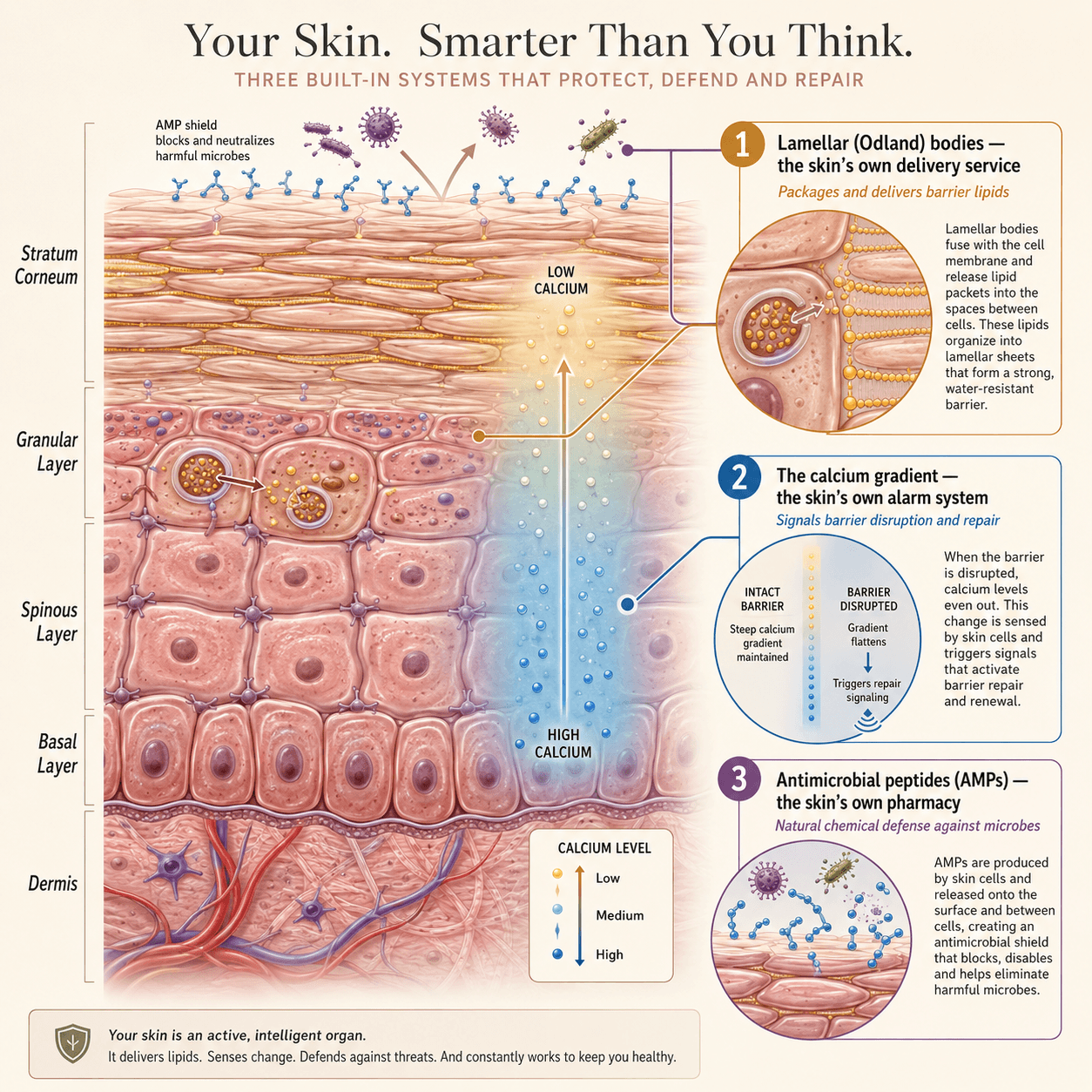
Lamellar (Odland) bodies — the skin's own delivery service
Deep in the epidermis, tiny organelles called lamellar bodies (also known as Odland bodies, after the researcher who first described them) do quiet, precise work. They package precise mixtures of lipids — ceramides, cholesterol, and long-chain fatty acids — and release them into the spaces between the outermost skin cells. Once released, the lipids self-assemble into stacked, ordered sheets, layered like the leaves of pastry. It is those sheets, arranged just so, that actually hold water inside the skin and keep the wrong things out.
- Whatever the visible condition — atopic dermatitis, rosacea, psoriasis, sun-weathered skin — the same finding shows up underneath: a measurable drop in total ceramide content, and a disorganised lamellar architecture. The surface differs. The substrate is the same.
- When the barrier is disrupted — over-cleansing, over-exfoliation, an acid the skin was not ready for — lamellar bodies begin secreting immediately. The body treats it as an emergency, because it is.
The calcium gradient — the skin's own alarm system
Just below the outermost layer of the skin sits an unusual arrangement of calcium — concentrated at the top, thinning as it goes deeper. This gradient is not decorative. It is one of the master signals telling immature skin cells when to become mature corneocytes, and it regulates the conversion of profilaggrin into filaggrin, a structural protein that shapes those corneocytes themselves. Without a functioning gradient, the assembly line stops.
- When the barrier is disturbed, the gradient collapses almost instantly. That collapse is not a symptom of the problem — it is the biochemical alarm that tells the lamellar bodies to release their reserves.
- Under ordinary conditions, the gradient recovers within 6 to 24 hours. Under chronic disruption — repeated harsh cleansing, constant strong acids, weekly peels — it never fully rebuilds, and the alarm begins to feel like the default state.
Antimicrobial peptides (AMPs) — the skin's own pharmacy
The epidermis is also its own pharmacy. Skin cells produce a family of small proteins — cathelicidins, beta-defensins, dermcidins — collectively called antimicrobial peptides, or AMPs. Their first job is to neutralise incoming pathogens directly. Their second, quieter job is to calibrate the skin's inflammatory response — keeping it from over-reacting to things that do not warrant it, and from under-reacting to things that do.
- When AMP expression goes wrong, the visible conditions follow. Under-expression of cathelicidin is one of the drivers of atopic dermatitis. Over-expression is one of the drivers of rosacea. Regulatory dysfunction shows up in psoriasis.
- The barrier, in other words, is not just a wall. It is immunological infrastructure — the outermost surface of the immune system, quietly deciding what to let past. When we say a strong barrier is a strong immune surface, this is what we mean literally.
The 1:1:1 lipid ratio — why it is not a rounding error
One of the specific technical claims that defines corneotherapy is the 1:1:1 molar ratio of ceramides, cholesterol, and free fatty acids. This is not a marketing simplification. It is the ratio the stratum corneum itself uses to assemble the lamellar structure that regulates TEWL and permeability.
The clinical significance is precise: topical lipid mixtures applied at the correct ratio accelerate barrier recovery. Mixtures applied at the wrong ratio — even when they contain all three classes of lipid — can delay recovery by disrupting the organisation of the lamellar sheets. In other words, a formula can contain 'ceramides' and still work against the barrier if the surrounding lipid composition is wrong.
This is why barrier-first formulation is not simply a matter of adding a ceramide to the ingredient list. It is a matter of the total lipid architecture the formula delivers.
TEWL — the number that describes barrier function
Transepidermal water loss (TEWL) is the rate at which water passively evaporates through the skin. It is the most widely used objective measure of barrier function in dermatological research, because a well-organised stratum corneum retains water and a disorganised one does not.
Elevated TEWL is characteristic of atopic dermatitis, rosacea, sensitive skin, over-exfoliated skin, and menopausal skin. It correlates with subjective reports of tightness, reactivity, stinging, and reduced tolerance for products that were previously fine.
A barrier-first practice treats TEWL as the direction of travel. Every action should, over weeks, be moving the barrier towards lower TEWL and greater tolerance — not towards higher tolerance for aggressive actives.
The 3 R's — the methodology, at introductory level
Corneotherapy organises its practice into three sequential and continuous actions, known as the 3 R's. They are not a routine — they are a framework for what a formulation should be doing. Each is explored more fully in our companion article on the 3 R's of menopausal skin, but at introductory level:
R1 — Repair
Restore the intercellular lipid matrix at the 1:1:1 molar ratio of ceramides, cholesterol, and free fatty acids.
- Plant-derived phytosterols, ceramide-like botanical lipids (rosehip, sea buckthorn, hemp seed), and long-chain fatty acids
- The goal is lamellar reorganisation — not surface occlusion
- Repair is the foundation; without it, replenishment and regeneration have nowhere to land
R2 — Replenish
Deliver botanical nutrients, humectants, and antioxidants that support the skin's natural repair processes, moisture balance, and environmental resilience.
- Botanical brighteners and licorice-derived actives help promote a more even-looking complexion.
- Beta-glucan, ectoin, tremella, aloe, and hyaluronic acid support hydration, comfort, and barrier recovery.
- Plant-derived polyphenols, tocopherols, and carotenoids provide targeted antioxidant support beneath — never in place of — daily sun protection.
R3 — Regenerate
Encourage cellular turnover without triggering inflammation.
- No abrasive mechanical exfoliation, no aggressive chemical resurfacing
- Bakuchiol as a gentler regenerative signal than retinoic acid for compromised barriers
- Adaptogenic actives that support the skin's own regenerative pace rather than force it
What barrier-first refuses to do
A methodology is defined as much by what it rejects as by what it prescribes. Corneotherapy is unusually specific on this point.
- It rejects aggressive chemical peels and high-percentage AHAs used as a routine practice — the barrier disruption they induce is not a controlled therapeutic tool but a chronic stressor
- It rejects mechanical resurfacing — microdermabrasion, scrubs with sharp particulates, aggressive brushes — because the calcium gradient and lamellar structure do not distinguish between a peel and an injury
- It rejects the 'break it to build it' framing — the idea that the skin must be controllably damaged in order to trigger regeneration; corneotherapy takes the view that regeneration is triggered more effectively by the removal of chronic barrier stress than by its addition
- It rejects the marketing of TEWL-elevating results (visible flaking, tightness, redness) as evidence of a product 'working'
- It rejects the assumption that a single generic protocol suits all skin — corneotherapy places heavy emphasis on individualised care based on observation of the skin's actual state week to week
The honest timeline
The most common reason a barrier-first practice is abandoned is that the timeline is not what people are told to expect. The mass-market skincare conversation is oriented around 7-day and 14-day claims. A compromised barrier does not respond on that clock.
Meaningful lamellar reorganisation takes 6 to 12 weeks. In that window, you should expect: tightness and reactivity to reduce first, product tolerance to improve, then hydration to feel more sustained between applications, then — over months, not weeks — visible calm, evenness, and resilience.
This is not a marketing timeline. It is what the biology is doing. A methodology that respects the biology has to name the timeline honestly.
Barrier-first as an editorial commitment
The reason corneotherapy is not a mass-market vocabulary is not that it is unproven — it is that the practice does not lend itself to fast claims, and the formulation criteria are strict. Educators and practitioners in the corneotherapy tradition have flagged a growing tendency of brands to describe products as 'corneotherapeutic' when they are simply, in the field's own phrase, 'skin-barrier-friendly' — without meeting the technical criteria.
The distinction matters. Barrier-friendly means the product does not obviously harm the barrier. Corneotherapeutic means the product actively supports lamellar reorganisation, respects the calcium gradient, protects the microbiome, and belongs to a system designed around the 3 R's. Not every formulation belongs in the second category. A brand that uses the word honestly has to be prepared not to use it for products that do not qualify.
That is what barrier-first, at its most honest, actually means — a formulation practice that stops when the biology asks it to stop.
Aphora Botanicals
How Aphora Practises Barrier-First
At Aphora Botanicals, barrier-first is the criterion every formulation is measured against — before scent, before texture, before any claim we might make on the front of the packaging. The question in every development conversation is the same one: does this action strengthen the stratum corneum, or compromise it? Everything else follows from the answer.
Practically, that means we compose around the 1:1:1 lipid architecture rather than around a single hero active. It means we choose fresh-batch anhydrous formats where the fragile bioactives are best protected, and we reserve refrigerated formats for the emulsions where the barrier work depends on the finest, most temperature-sensitive lipids. It means we do not build products around aggressive peels, high-percentage AHAs, or any 'break it to build it' framing — because those actions ask the skin to accept controlled damage, and we are not persuaded by the case.
Corneotherapy is not a term we use lightly. When we do use it, we use it because the formulation genuinely qualifies — and that is a standard we intend to keep.
Comparison
| Break-It-To-Build-It Aesthetics | Barrier-First (Corneotherapy) Methodology | |
|---|---|---|
| Core assumption | Controlled damage is required to trigger renewal | Renewal is best triggered by removing chronic barrier stress |
| Signature actives | High-percentage AHAs, retinoic acid, aggressive resurfacing | Ceramide-cholesterol-fatty acid at the 1:1:1 ratio, botanical brighteners, tremella and beta-glucan for hydration, plant-derived antioxidants, bakuchiol |
| Attitude to TEWL | Accepted as a short-term cost of visible results | Treated as the primary objective measure of progress |
| How progress looks | Visible flaking, tightness, and redness accepted as 'working' | Reactivity reduces, tolerance improves, hydration sustains — quietly |
| Attitude to the microbiome | Rarely considered; harsh cleansers and disruptive actives common | Actively protected; acid mantle and microbial diversity preserved by design |
| Honest timeline | 7 to 14 day claims | 6 to 12 weeks for lamellar reorganisation and measurable barrier recovery |
| What is optimised for | Immediate visible change | Sustained tolerance, resilience, and skin autonomy |
Frequently Asked Questions
Common Questions
Corneotherapy is an evidence-based skincare methodology founded by Professor Albert M. Kligman that treats the stratum corneum — the outermost layer of the skin — as the primary site of intervention. Rather than trying to force change from below through aggressive resurfacing, corneotherapy works by restoring the barrier's own lipid architecture, immune function, and regenerative capacity. Aphora is not a professional aesthetics practice, but the principles of corneotherapy — the 1:1:1 lipid ratio, the 3 R's framework, the non-aggressive stance — inform every formulation decision we make.
Increasingly, yes — the phrase is being used loosely across the industry. Behind the phrase, when it is used with intent, sits the specific methodology of corneotherapy: restore the 1:1:1 lipid ratio in the stratum corneum, protect the calcium gradient and antimicrobial peptides, avoid actions that raise transepidermal water loss, and organise the routine around the 3 R's. Where a brand uses barrier-first with that discipline, it is meaningful. Where the phrase is used without those criteria, it is atmosphere.
The 1:1:1 refers to the molar ratio of ceramides, cholesterol, and free fatty acids — the three lipid classes that assemble into the lamellar sheets of the stratum corneum. Topical mixtures applied at this ratio accelerate barrier recovery. Applied at the wrong ratio, even mixtures containing all three lipids can delay recovery by disrupting the organisation of the sheets. It is the reason 'contains ceramides' on an ingredient list is not, by itself, a barrier-repair claim.
TEWL — transepidermal water loss — is the rate at which water passively evaporates through the skin. It is the most widely used objective measure of barrier function in dermatological research. A well-organised stratum corneum retains water; a disrupted one does not. Elevated TEWL is characteristic of atopic dermatitis, rosacea, over-exfoliated skin, and menopausal skin. A barrier-first practice treats reducing TEWL as the primary direction of travel.
Not because acids or peels have no clinical use — they do, in defined clinical contexts. Corneotherapy rejects them as a routine daily practice because the barrier disruption they induce is not a controlled therapeutic tool at home but a chronic stressor. The calcium gradient collapses each time, lamellar bodies are forced into emergency secretion, and cathelicidin regulation is destabilised. Repeated, that pattern trains the skin into chronic reactivity rather than resilience.
Meaningful lamellar reorganisation takes 6 to 12 weeks. In that window, reactivity and tightness reduce first, product tolerance improves, hydration begins to sustain between applications, and only then does visible calm, evenness, and resilience emerge. This is not a marketing timeline — it is what the biology is doing. The most common reason a barrier-first practice is abandoned is that people were told to expect 7-day results and the barrier cannot deliver them.
No. Barrier-first is a methodology, not a skin type. All skin — sensitive, resilient, oily, mature — is downstream of the stratum corneum. Even skin that appears robust benefits from lower TEWL, a more balanced microbiome, and better-organised lamellar structure. Sensitive and menopausal skin often show the most dramatic gains from the methodology because their starting point is more compromised, but the underlying practice is the same.
Repair — restore the intercellular lipid matrix at the 1:1:1 ratio. Replenish — deliver the essential micronutrients (niacinamide, panthenol, antioxidants) the skin needs to sustain its own defences. Regenerate — encourage cellular turnover without triggering inflammation, using gentler regenerative signals such as bakuchiol rather than retinoic acid on a compromised barrier. Applied to menopausal skin specifically, each R takes on a distinct shape — explored in our companion article on the 3 R's of menopausal skin.
Yes, and the distinction is one practitioners in the corneotherapy tradition have been careful to preserve. Barrier-friendly means the product does not obviously harm the barrier. Corneotherapeutic means the product actively supports lamellar reorganisation, respects the calcium gradient, protects the microbiome, and belongs to a system designed around the 3 R's. Many perfectly good formulations are the first without being the second. Using the second word for both is what dilutes the term.
Continue Reading