Soothing · Sensitive · Barrier-First
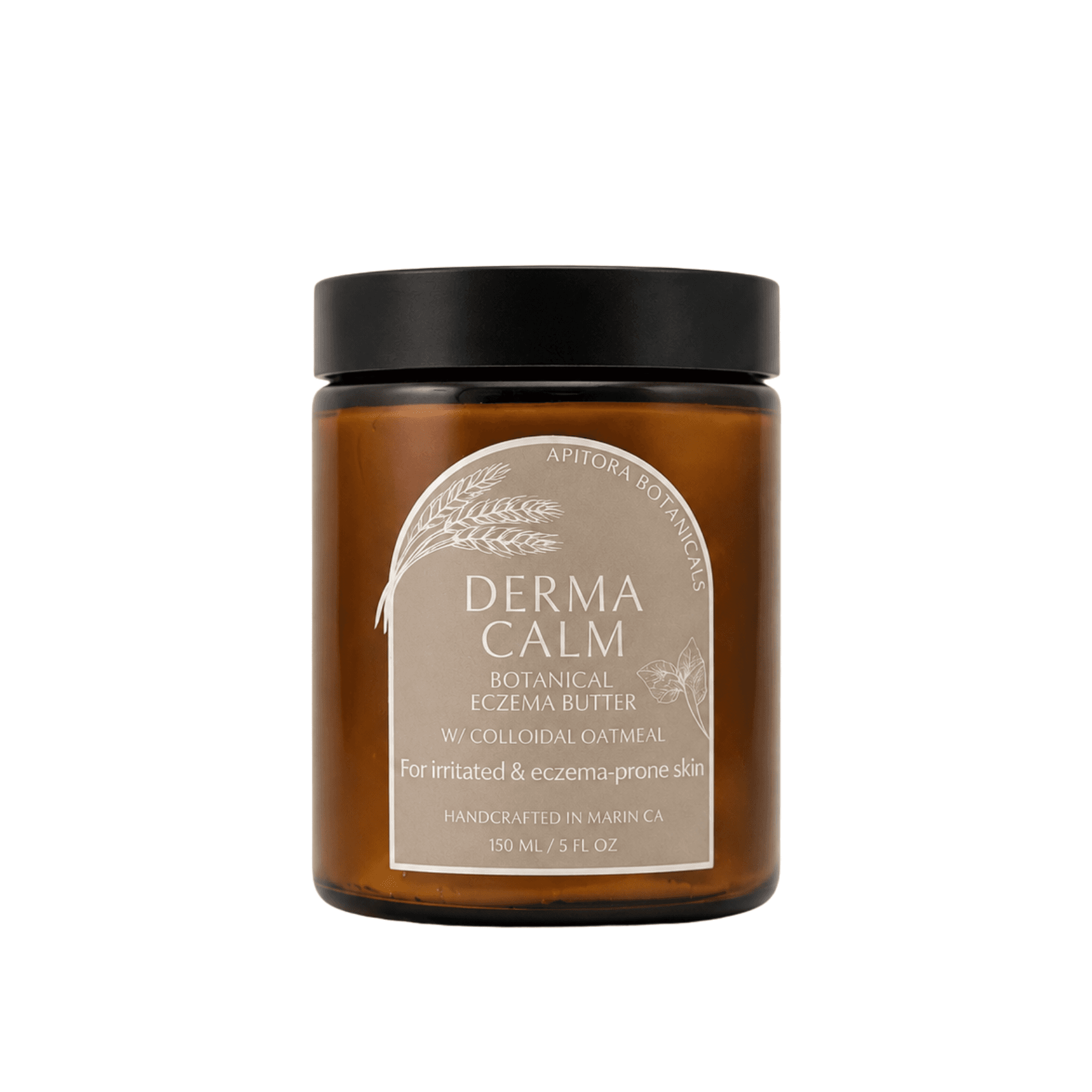
Derma Calm
Botanical Body Butter
A botanically dense butter for dry, irritated, easily reactive skin — built around colloidal oatmeal and the calmest oils in the apothecary.
$40.00
Free US shipping on orders of $75 or more
In Short
Derma Calm is a barrier-soothing botanical body butter built for sensitive, reactive skin that is easily provoked. Colloidal oatmeal sits at the center of it — finely milled whole oat, the most studied botanical there is for skin that needs leaving alone — alongside neem, tamanu, evening primrose, rosehip, and a triple butter base of Shea, Mango, and Cupuaçu. Lavender and Roman Chamomile are dosed at the minimum that does anything, chosen for tolerability rather than for scent.
Format
Whipped anhydrous body butter
Skin Type
All skin types — especially dry
When
Morning or night, after bath or shower
Application
On clean, slightly damp skin
The Philosophy
For skin that has been asking for quieter care.
Most rich body butters on the market are formulated for normal-to-dry skin and dosed with essential oils for fragrance. They aren't designed with reactive skin in mind — and the result, for many people whose skin reacts to almost everything, is irritation rather than relief.
Derma Calm was built the other way around. The starting point was: what is the gentlest, most barrier-respectful butter we could formulate, that still does meaningful work? The answer is colloidal oatmeal at the center, the most well-tolerated botanical oils in the apothecary around it, and essential oils at therapeutic minimum.
The Scent
Therapeutic-Dose Aromatherapy
Essential oils chosen for what they do to the nervous system — not just how they smell.
Top
Lavender (low-dose)
Heart
Roman Chamomile
Base
Botanical-base notes
Built for reactive skin
Where the other body butters in the range use essential oils for mood and ritual, Derma Calm uses them sparingly — chosen for tolerability on compromised skin first, scent second.
Settling rather than performing
Roman Chamomile and low-dose Lavender are among the lowest-irritation aromatic actives in cosmetic use. The scent is faint and supportive rather than forward.
Dosed for skin that reacts
The dosing here is intentionally below the threshold most reactive skin tolerates. We recommend Derma Calm as a daily maintenance butter, including through the stretches when skin is at its most easily provoked.
The Science
Active Architecture
Every ingredient chosen for what it does in the formula — never as filler, never as marketing.
Colloidal Oatmeal
Avena sativa (Oat) Kernel Flour — finely milled
Mechanism. Finely milled whole oat, suspended rather than dissolved. Its avenanthramides are the phenolic compounds oats are valued for, and the milled flour forms a soft film that sits on the surface rather than sinking in.
Outcome. Skin that feels settled rather than tight, under a film you can feel but not see.
Neem Oil
Azadirachta indica seed oil
Mechanism. Cold-pressed neem seed oil, used at low dose. A dense, bitter oil traditionally reserved for skin that has had a hard time of it — included for its lipid profile rather than its reputation.
Outcome. A less reactive surface, without the heaviness neem can bring at higher doses.
Tamanu Oil
Calophyllum inophyllum seed oil
Mechanism. Polynesian seed oil, cold-pressed and unusually rich — thick, green and distinctly resinous. Carries calophyllolide, the compound the oil is studied for, alongside a high proportion of fatty acids the barrier can use directly.
Outcome. A softer, more comfortable surface where skin has been under strain.
Evening Primrose Oil
Oenothera biennis seed oil
Mechanism. Cold-pressed seed oil, unusually rich in gamma-linolenic acid — an omega-6 fatty acid that occurs in very few plants, and one the barrier can use directly. Fragile enough that it belongs in a fresh batch rather than on a shelf.
Outcome. A better-fed barrier, from a lipid most formulas leave out.
Rosehip Seed Oil
Rosa canina fruit oil
Mechanism. Cold-pressed from the fruit, and one of the richest botanical sources of linoleic acid — the fatty acid reactive skin is most often short of. Carries the carotenoids that give the oil its color.
Outcome. More even tone, from a lipid the barrier is usually missing.
Shea Butter
Butyrospermum parkii (Shea) butter
Mechanism. Unrefined West African shea butter rich in unsaponifiables — including tocopherols and triterpenes that support barrier repair. Among the most well-tolerated heavy emollients in cosmetic use.
Outcome. Deeply nourished, lipid-replete skin with no occlusive heaviness.
Cupuaçu Butter
Theobroma grandiflorum seed butter
Mechanism. Amazonian butter rich in phytosterols and fatty acids — capable of holding up to 240% of its weight in water. Repairs the lipid layer deeper than most surface emollients.
Outcome. Deep, lasting hydration of dry, depleted skin.
The Comparison
Body Butter vs Body Lotion
Two approaches to body care. One replenishes the barrier. The other rides on top of it.
| Derma Calm Body Butter | Standard Body Lotion | |
|---|---|---|
| Base | Whole botanical butters and cold-pressed oils | Water, emulsifier, and a light oil fraction |
| Fragrance load | Essential oils at the minimum that does anything | Fragrance dosed for scent, often undisclosed |
| Preservative load | Minimal — anhydrous, no water phase | Heavy — water phase requires preservation |
| Mineral oil / petrolatum | None | Often the primary occlusive base |
| Lipid replacement | Shea, mango and cupuaçu — the lipid classes skin uses | Occlusive film over the surface |
| Sensorial | Rich whipped butter that absorbs slowly | Absorbs fast, often needs reapplying |
Outcomes
What You'll Notice
From the First Use
- Immediate comfort on tight, uncomfortable skin
- A felt protective film without heaviness
- No tingling, no stinging, nothing that announces itself
Within Weeks
- Smoother, less reactive surface
- Less visible redness
- Improved barrier-water-retention
With Continued Use
- Lower baseline reactivity
- Skin that is provoked less easily
- More resilient daily barrier function
At Aphora Botanicals
The opposite of louder. The opposite of more.
Reactive skin doesn't need stronger actives. It needs fewer, gentler, more deliberate ones — at therapeutic minimum and in the right matrix.
Derma Calm is built around that principle. Colloidal oatmeal is the most studied botanical in this whole territory, and it has earned that by doing very little very reliably. The supporting cast — neem, tamanu, evening primrose, rosehip — are the calmest botanical oils in the apothecary. The result is a body butter that does its work quietly.
Made for those who recognize the difference.
The Ritual
How to Use
- One
Patch-test first.
On the inner forearm, 24 hours. Standard practice for any new product on reactive skin — this isn't a sign Derma Calm is harsh, it's a sign you're paying attention.
- Two
Apply to clean, slightly damp skin.
After a short, lukewarm shower (never hot — heat strips the barrier). Towel-dry gently and leave a touch of moisture on the surface.
- Three
Massage gently wherever skin feels tight or irritated.
Generous application is fine; the formula won't sit greasy. Where skin is particularly reactive, pat or sweep softly rather than rubbing, to avoid disrupting the surface further.
- Four
Daily as maintenance, or as needed.
Derma Calm is designed for ongoing daily use, not as an occasional rescue. Consistent application is what keeps the barrier resilient over time.
What's Not Inside
Clean by formulation, not by claim.
Full Ingredients
A botanical dispensary in one jar.
Butyrospermum Parkii (Shea) Butter, Mangifera Indica (Mango) Seed Butter, Theobroma Grandiflorum (Cupuaçu) Seed Butter, Helianthus Annuus (Sunflower) Seed Oil, Vitis Vinifera (Grape) Seed Oil, Simmondsia Chinensis (Jojoba) Seed Oil, Rosa Canina (Rosehip) Fruit Oil, Oenothera Biennis (Evening Primrose) Oil, Calophyllum Inophyllum (Tamanu) Seed Oil, Azadirachta Indica (Neem) Seed Oil, Avena Sativa (Oat) Kernel Flour (Colloidal Oatmeal), Maranta Arundinacea (Arrowroot) Root Powder, Tocopherol (Vitamin E), Lavandula Angustifolia (Lavender) Oil*, Anthemis Nobilis (Roman Chamomile) Flower Oil.
* Essential oils dosed at therapeutic minimum for tolerability on reactive skin. Derma Calm is anhydrous — no preservative system is required.
Questions
What People Ask About Derma Calm
A whipped body butter is anhydrous — it contains no water. That means a much higher concentration of actives per gram (butters, plant oils, lipid-mimetics) and almost no preservative system, since microbes need water to grow. Lotions are mostly water held together by surfactants, with humectants drawing moisture into the upper layer of skin. A butter does the opposite: it replenishes the lipid barrier itself. For dry, dehydrated, or mature skin, the difference is felt within a week of consistent use.
Not when whipped to this texture. Air is incorporated into the formula so the butter melts on contact, absorbing within a minute or two without leaving a film. The trick is the application: clean, slightly damp skin (after shower) allows the lipids to bind with surface water and absorb cleanly. Applied to bone-dry skin, any rich butter can sit longer — so let the formula meet a little moisture.
Store in a cool, dark place away from direct sun and radiators. The natural butters in the formula soften above approximately 26°C (78°F) — which is why we ship body butters from September through April only. A butter that arrives melted will re-solidify, but the texture and aroma can suffer. If the climate where you live runs warm year-round, keep the jar in a cool cupboard or even the bottom shelf of the fridge.
The base formula is built around well-tolerated, non-comedogenic ingredients: Cupuaçu, Mango and Coconut butters with olive-derived Squalane. Essential oils carry the scent in each composition — and while we use therapeutic-dose, skin-grade oils, anyone with documented essential-oil sensitivity should patch-test first on the inner forearm for 24 hours. For skin that reacts easily, see Derma Calm — built around colloidal oatmeal for exactly that.
The formula is deliberately gentle and the essential oils are dosed at the minimum that does anything. For children under two, or anyone using a prescribed topical product, ask your doctor before adding anything new — not because Derma Calm is strong, but because that is the right order to do things in. Patch-test on the inner forearm for 24 hours, as you would with any new product on reactive skin.
Yes. It is an anhydrous butter, so it layers over anything water-based without interfering. If you are using something prescribed, apply that first and let it absorb before the butter goes on top — and check with whoever prescribed it.
Continue Reading