Skin Biology & Formulation
The Holistic Skin Barrier Guide
Quick Answer
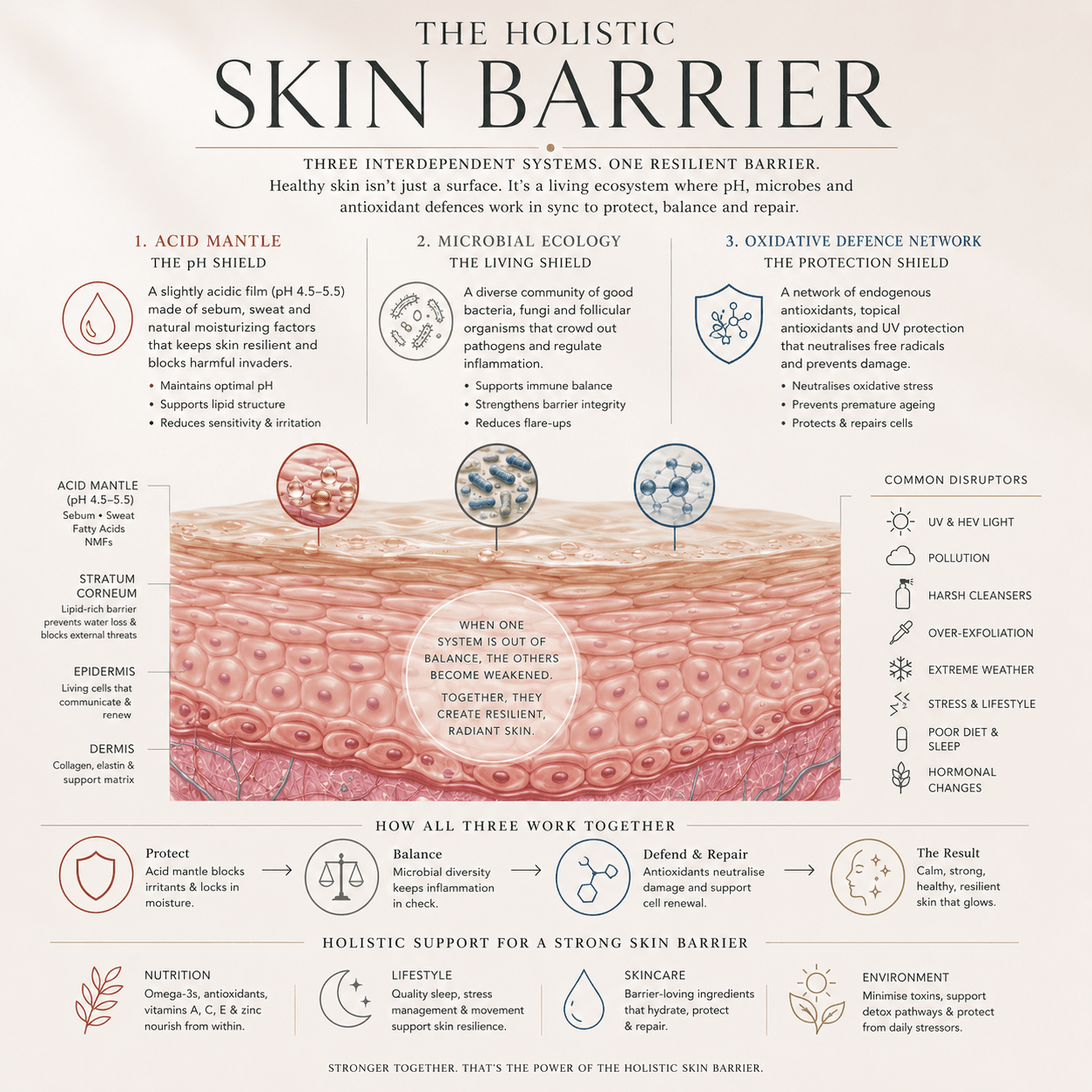
The skin barrier is not a single layer but three interdependent systems working together: the acid mantle (surface chemistry at pH 4.5–5.5), the microbial ecology (the trillions of commensal organisms living on the skin), and the oxidative defence network (endogenous and topical antioxidants paired with UV protection). When all three are supported, skin tolerates treatment, recovers quickly, and stays calm. When any one is compromised, the others begin to drift. Healthy barrier function is the outcome of supporting all three — not of treating any in isolation.
Key Facts
System one
The acid mantle — surface film of sebum, sweat, and fatty acids at pH 4.5–5.5
System two
The microbial ecology — trillions of commensal bacteria, fungi, and follicular mites that calibrate immune response
System three
The oxidative defence network — endogenous antioxidants, topical antioxidants, and UV filters working together
Common failure point
Alkaline cleansers (pH 9–10) destabilise all three systems simultaneously by shifting surface pH
Aphora Botanicals
Formulates with Bakuchiol, cold-pressed rosehip, sea buckthorn, astaxanthin, and Leuconostoc Ferment to support all three systems
The skin barrier as a system, not a surface
Most skincare is sold against the skin — formulated to strip, resurface, neutralise, or correct what is already functioning. This guide takes a different position. The skin barrier is not a problem to be managed. It is a living architecture of three interdependent systems, each evolved to keep the body intact in an environment that is, biochemically speaking, constantly trying to oxidise it.
When all three systems are supported, skin behaves predictably. It tolerates treatment. It recovers quickly. It stays quiet. When any one of them is compromised, everything else begins to drift.
A compromised acid mantle destabilises the microbiome. A disrupted microbiome weakens immune signalling. A depleted antioxidant system accelerates oxidative damage that, in turn, breaks down lipids and inflames the surface. None of these systems function in isolation, and no serum, regardless of how it is marketed, can repair one while ignoring the other two.
System one — the acid mantle
The acid mantle is a thin, slightly acidic film — a blend of sebum, sweat, shed corneocytes, and fatty acids — that sits at pH 4.5–5.5. It is not decorative. It is functional.
When the acid mantle is intact, the stratum corneum can assemble its characteristic brick-and-mortar lipid matrix — ceramides, cholesterol, and free fatty acids in roughly a 50:25:15 ratio. When pH drifts alkaline, that organisation loosens. Water leaves. Irritants enter.
Traditional bar soaps routinely test at pH 9–10. A single alkaline wash can take the skin hours to recover. A daily alkaline wash asks the skin to rebuild its chemistry every morning from a deficit.
- Inhibits pathogenic bacteria, which prefer a neutral pH
- Keeps the barrier's lipid-organising enzymes active — these enzymes are pH-dependent
- Regulates the proteases responsible for inflammation
- Governs transepidermal water loss (TEWL)
Signs the acid mantle is compromised
- Skin feels tight or 'squeaky' immediately after cleansing
- A persistent, low-grade pink undertone that never fully settles
- Products that previously felt neutral now sting on application
- Increased sensitivity to climate, wind, or temperature shifts
- Slower recovery from minor breakouts or marks
System two — the microbial ecology
The skin is not sterile. It is inhabited. A healthy face hosts trillions of microorganisms — commensal bacteria such as Staphylococcus epidermidis, fungi, and mites that live in the follicles. The microbiome is not evenly distributed. The forehead is more sebaceous than the cheek. The nose differs from the jawline. Each region is its own small climate.
The microbiome is how the skin learns what to ignore. Depleted biomes are reactive biomes — and reactive skin is skin that cannot tell the difference between a genuine threat and a hydrosol.
- Competes with pathogenic organisms for space and nutrients
- Produces metabolites that maintain acidic pH
- Communicates with the skin's immune system, calibrating inflammatory response
- Supports wound healing and post-inflammatory recovery
The clarifying-product paradox
The language of mainstream skincare frames the microbiome as contamination. Clarifying. Purifying. Detoxifying. Foaming washes, high-concentration essential oils, and antibacterial actives used prophylactically do not reset the skin. They evict the organisms that were keeping it stable.
Skin that was mildly congested becomes cystic after a course of purifying products. Skin that was dull becomes inflamed. The barrier was not the problem. The treatment was.
Aphora formulates essential oils at below 0.1% of total mass — sufficient for sensory signature, far below any antimicrobial threshold. Most natural-skincare formulations use essential oils at 1–2%, which is pharmacological at the biome level.
Signs the microbiome is depleted
- Products that felt neutral a month ago now sting
- Small clustered follicular bumps around the mouth, cheeks, or jawline
- Shiny but dehydrated skin — oil on the surface, tightness underneath
- Slow post-breakout healing
- A persistent, low-grade itch with no rash
System three — the oxidative defence network
Every day the skin is exposed to ultraviolet radiation, pollution particulates, tobacco smoke, blue light, and internal metabolic stress. These generate free radicals — unstable oxygen species that, unchecked, damage cell membranes, oxidise lipids, cross-link collagen, and mutate DNA.
The skin has an endogenous antioxidant system (superoxide dismutase, catalase, glutathione) that handles ordinary oxidative load. Modern environmental load is not ordinary. Topical antioxidants and broad-spectrum UV filters are not optional additions — they are replacements for a defensive capacity the skin can no longer produce in sufficient quantity.
Neither component works alone. Sunscreen without antioxidant support leaves residual oxidative damage unchecked. Antioxidants without SPF is a garden hose against a wildfire.
Signs the oxidative system is overwhelmed
- Skin that burns or pigments quickly under sun exposure
- Dull, ashen, or grey undertone
- Post-inflammatory hyperpigmentation that lingers for months
- Visible photoaging — fine lines and laxity appearing faster than expected
Ingredients that compromise the barrier
The following ingredients appear across mainstream skincare. Used daily, layered, or in already-compromised barriers, they cause the slow degradation this guide is written against.
Harsh surfactants that strip barrier lipids
- Sodium Lauryl Sulfate (SLS)
- Sodium Laureth Sulfate (SLES)
- Ammonium Lauryl Sulfate
- Ammonium Laureth Sulfate
- Sodium C14-16 Olefin Sulfonate
- Sodium Myreth Sulfate
Aggressive degreasers used without barrier support
- Benzoyl peroxide used daily
- High-percentage sulphur without barrier-rebuilding co-formulation
- SD alcohol or ethanol ranked high on an ingredient list
Biome-disruptive antimicrobials
- Triclosan
- Chlorhexidine
- High-concentration essential oils — tea tree, oregano, thyme, clove, cinnamon bark, eucalyptus
Alkaline shifters
- Undiluted apple cider vinegar
- Sodium bicarbonate masks
- Traditional bar soap on the face
Preservation systems Aphora never uses
- Parabens
- Formaldehyde-releasing preservatives — DMDM hydantoin, imidazolidinyl urea, quaternium-15, bronopol
- Methylisothiazolinone (MI) and methylchloroisothiazolinone (MCI)
- Ethylhexylglycerin
- Synthetic fragrance
- Silicones, petrochemicals, microplastics, PEGs
Bioactives that genuinely support the three systems
Aphora formulates with a small, deliberately chosen set of bioactives. Each is selected for measurable function, not romantic narrative.
For the acid mantle and lipid matrix
- Cold-pressed rosehip oil — high in linoleic and alpha-linolenic acids; supplies the fatty acid precursors the skin uses to build its own ceramides
- Sea buckthorn — dense in omega-7 palmitoleic acid, carotenoids, and tocopherols
- Meadowfoam and jojoba — structurally similar to human sebum; integrate into the lipid matrix without occluding
- Unrefined shea butter — delivers phytosterols and triterpenes that support enzyme function
For the microbial ecology
- Leuconostoc/Radish Root Ferment Filtrate — fermentation-derived, biome-compatible preservation active
- Whole-flower marigold (calendula) infusion — supports follicular calm
- Rose and rose geranium hydrosols — pH-appropriate water phase that hydrates without disrupting microbial pH
- Colloidal oatmeal and chamomile — quiet the overactive immune signalling of a disrupted biome
For the oxidative defence network
- Bakuchiol — plant-derived retinol alternative; stimulates collagen synthesis without the barrier disruption of retinoic acid
- Astaxanthin — among the most potent lipid-phase antioxidants known
- Tocopherols (vitamin E) — protect membrane lipids from peroxidation
- Raspberry seed oil — barrier-supporting fatty acids with intrinsic UV-attenuating properties
- Non-nano zinc oxide — mineral UV filter that reflects rather than absorbs; sits on the surface without disrupting the biome
The Aphora ritual — rebuilding step by step
The ritual below is structured around the three systems. Each step corresponds to a specific mechanism of barrier support.
Cleanse — TERRA GLOW Rose Bloom & Balance Cleansing Face Oil
- An oil-to-milk botanical cleanser. Dissolves sunscreen, sebum, and particulate without stripping the lipid layer or disturbing the acid mantle. The foundation step for any compromised barrier.
Tone — TERRA GLOW Rose Tonic Mist
- Damask rose hydrosol with naturally derived AHAs — lactic and citric acid — buffered to a pH the microbiome tolerates. Restores the water phase and returns the surface to its target pH.
Treat (Day) — TERRA GLOW Protect Day Face Oil
- Anhydrous antioxidant defence layer. Designed to be worn under mineral SPF. Delivers tocopherols, carotenoids, and linoleic-rich oils to the oxidative defence network before daily UV and pollution exposure.
Treat (Night) — TERRA GLOW Recovery Night Face Oil
- Anhydrous, Bakuchiol-led overnight renewal. Stimulates collagen synthesis and supports cellular turnover without the barrier disruption of retinoic acid.
Seal — TERRA Lumé Deep Hydration Face Cream
- Barrier-reinforcing moisturiser. Delivers both humectant water and lipid occlusion. Refrigeration recommended — a consequence of efficacy-life formulation, not a compromise.
Weekly — TERRA GLOW Mask
- Powder-activated detox mask, mixed fresh at the point of use. Replaces the clarifying product category with something the biome can tolerate. Australian kaolin clay draws without stripping.
Whole body — TERRA GLOW Head to Toe Botanical Oil
- Anhydrous multi-use oil with whole-flower marigold infusion. Body, hair, scalp, beard. Extends barrier logic beyond the face, where most routines abandon it entirely.
Aphora Botanicals
The Aphora Botanicals Approach to Barrier Support
At Aphora Botanicals, every formula is designed against the three-system framework set out in this guide. Cleansers are pH-appropriate. Hydrosols and treatment oils are formulated to integrate with the microbial ecology rather than override it. Antioxidants are selected for measurable function and delivered in fresh-batch formulations that arrive with their potency intact.
Our actives — Bakuchiol, cold-pressed rosehip, sea buckthorn, astaxanthin, Leuconostoc Ferment, whole-flower marigold infusion — share a single liability: biological activity has a window. Linoleic-rich oils oxidise. Carotenoids degrade under light and heat. Tocopherols are consumed protecting the actives around them. A formula that sits in a warehouse for twelve months before reaching the skin is not the same formula that left the laboratory. The ingredient list is identical. The chemistry is not.
We optimise for efficacy life rather than shelf life. Batches are sized to the potency window of the ingredients inside them. Production-to-skin is measured in weeks, not months. Cool storage is recommended for select formulas — a design choice, not a preservation workaround. Made for those who recognise the difference.
Comparison
| Conventional Barrier Care | Three-System Barrier Support | |
|---|---|---|
| Framing of the barrier | A single surface to be repaired with ceramides | Three interdependent systems — acid mantle, microbiome, oxidative defence |
| Cleansing approach | Foaming surfactants, often pH 7–10 | Oil-to-milk cleansing, pH-appropriate, biome-compatible |
| Treatment of microbiome | Treated as contamination — clarifying, purifying actives | Treated as ecology — supported with ferments, hydrosols, low-concentration botanicals |
| Antioxidant strategy | Single-vitamin serums (often vitamin C alone) | Layered system — Bakuchiol, astaxanthin, tocopherols, carotenoid-rich oils |
| Formulation lifecycle | 24–36 month shelf life; high-load preservation | Fresh-batch; efficacy-life optimised; gentle preservation |
| Outcome target | Visible immediate effect | System resilience and predictable behaviour over time |
Frequently Asked Questions
Common Questions
The skin barrier is best understood as three interdependent systems working together. The acid mantle is the slightly acidic surface film of sebum, sweat, and fatty acids at pH 4.5–5.5 that controls enzyme activity and inhibits pathogens. The microbial ecology is the trillions of commensal bacteria, fungi, and follicular mites that compete with pathogens and calibrate the skin's immune response. The oxidative defence network is the combination of endogenous antioxidants, topical antioxidants, and UV filters that protect cell membranes, lipids, and DNA from free radical damage. Healthy barrier function is the outcome of supporting all three together.
A compromised barrier presents subtly at first. Common signs include: products that previously felt neutral now sting on application, skin that feels tight or squeaky after cleansing, a persistent low-grade pink undertone, small clustered follicular bumps around the mouth or jaw, shiny but dehydrated skin (oil on the surface but tightness underneath), slow healing of breakouts or marks, and increased sensitivity to climate or temperature shifts. If multiple of these patterns are present, the barrier is signalling that one or more of its systems is depleted.
Essential oils are powerful plant chemistries. At cosmetic-standard concentrations of 1–2%, they can be antimicrobial to the point of disrupting the skin microbiome — particularly tea tree, oregano, thyme, clove, cinnamon bark, and eucalyptus. The concentration and frequency matter more than the presence. Aphora formulates essential oils at below 0.1% of total mass — sufficient for sensory signature, far below any antimicrobial threshold to the biome.
Bakuchiol is a plant-derived compound (from Psoralea corylifolia) that has been shown in clinical studies to stimulate collagen synthesis and support cellular turnover with comparable visible results to retinoic acid — but without the barrier disruption, photosensitivity, and acid-mantle compromise associated with retinoid use. For a brand built around three-system barrier support, Bakuchiol delivers the renewal benefit without undermining the systems the rest of the formulation is designed to protect. It is featured as the lead active in our RECOVERY Night Face Oil.
Our companion article, Understanding the Skin Barrier, focuses on the architectural detail of the stratum corneum — the brick-and-mortar lipid matrix of ceramides, cholesterol, and fatty acids that gives the barrier its physical structure. This Holistic Skin Barrier Guide takes a wider lens, treating the barrier as three interdependent systems (acid mantle, microbial ecology, oxidative defence) and outlining how Aphora's bioactives and ritual support each one. Read together, they give a complete picture of barrier biology and barrier care.