Physiological Beauty
Skin Is Built From the Inside, Too
Quick Answer
Skin isn’t only a surface you care for. It’s tissue your body builds and rebuilds every day, from what it has to work with. Vitamin C and protein go into collagen. The fats you eat go into the barrier. Sugar, sun and chronic inflammation wear both down. A large study of American women aged 40 to 74 found that those who ate more vitamin C and more linoleic acid were less likely to have dry, wrinkled-looking skin. Daily sunscreen is still the best-proven habit for skin over the long run. Food supports the systems sunscreen protects. Good skincare supports the surface those systems produce. It takes all three.
Key Facts
The idea
Skin is built from the inside and protected from the outside. Neither replaces the other
Collagen needs
Vitamin C, which the body can’t make, and enough protein
The barrier needs
Essential fatty acids, especially linoleic acid, which the body also can’t make
What wears collagen down
UV, chronic inflammation, and glycation: sugar binding to collagen and stiffening it
The gut
Linked to skin through the immune system. Promising research, not yet proof that changing the gut changes how skin ages
The best-proven habit
Daily sunscreen. In a trial lasting four and a half years, daily users showed no detectable increase in skin aging
Skin isn’t a surface. It’s an organ.
Skincare likes to talk about skin as a surface: something you cleanse, treat and cover. It is a surface. It’s also living tissue, the largest organ you have, and your body rebuilds it continuously from whatever raw materials it has on hand.
That means what you eat, how well you sleep, how much inflammation your body is carrying and how much sun you get all show up in your skin, slowly, over years. Nothing you put on your face can supply a raw material your body is short of.
None of this is new to us. We formulate barrier-first because we think of skin as a system, not a canvas. This entry is about the part of that system we don’t make: the part that comes from your plate.
Collagen is made and broken down every day
Collagen is the protein that gives skin its structure and spring. It isn’t laid down once and kept. Your body makes it and breaks it down all the time, and the way skin looks over the decades depends on the balance between the two.
Making collagen needs two things from your diet. The first is vitamin C, which the cells that build collagen can’t work without, and which the human body can’t make for itself. The second is protein, which supplies the amino acids collagen is built from.
Breaking collagen down is driven by enzymes, and several things turn those enzymes up: UV light, above all, and the oxidative stress and low-grade inflammation that come with smoking, poor sleep and diets heavy in processed food.
In the menopausal years, the balance tips. With less estrogen, skin makes less collagen than it loses, and that shift is fastest in the first few years after menopause. That doesn’t make diet more important than it was. It makes the margin smaller, so the basics count for more.
Sugar stiffens collagen
There’s a slower process too. When sugar in the bloodstream binds to proteins like collagen, it forms cross-links called advanced glycation end products. Collagen that has been glycated is stiffer, less elastic and harder for the body to repair or replace.
Glycation happens in everyone and builds up with time. A diet consistently high in sugar and refined starch gives it more to work with. You can’t avoid it. You can avoid feeding it.
The barrier is built from fats you have to eat
The skin barrier, the thin outer layer that keeps water in and irritants out, is built from fats: ceramides, cholesterol and free fatty acids, held in a precise balance. One of the fatty acids it depends on most is linoleic acid, an omega-6 the body can’t make. It has to come from food.
That’s the link the research shows most clearly. In a study of more than 4,000 American women aged 40 to 74, those who ate more linoleic acid were less likely to have age-related dryness and thinning skin. Those who ate more vitamin C were less likely to have a wrinkled appearance and dryness. The study adjusted for age, sun exposure, income and other factors, and it is observational, so it shows a link, not proof of cause. It’s still one of the largest looks at the question there is.
Your barrier is supported from both sides. From the inside, by the fatty acids you eat. From the outside, by fresh plant oils rich in the same fatty acids, applied to the surface. That’s the principle our formulas are built on, and it’s the same principle a good diet works on.
The gut and the skin talk to each other
The bacteria in your gut help train your immune system, and your immune system reaches every part of the body, skin included. Researchers call this connection the gut–skin axis, and they have found links between changes in the gut microbiome and several inflammatory skin conditions.
Here it’s worth being careful. A link is not the same as a lever. There is not yet good evidence that changing your gut microbiome slows how your skin ages. What is well established is that a diet rich in fiber from vegetables, legumes and whole grains feeds a healthier gut, and that this is good for the rest of you. If it turns out to be good for your skin as well, that’s a bonus you’ll already be collecting.
What to eat, in one sentence
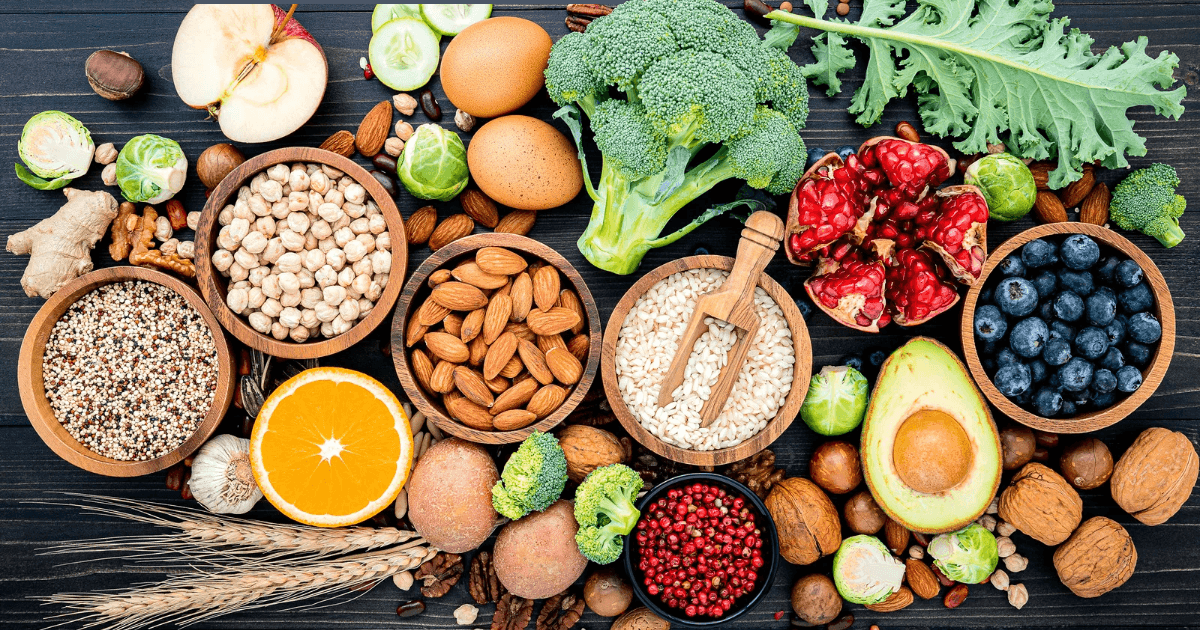
Eat the way people around the Mediterranean have long eaten: plenty of vegetables, legumes, whole grains, fruit and nuts, extra-virgin olive oil as your main fat, and oily fish a couple of times a week.
That one pattern covers almost everything above. Vitamin C from fruit and vegetables. Protein from legumes, fish and nuts. Essential fatty acids from olive oil, nuts, seeds and fish. Fiber for the gut. Less refined sugar to feed glycation. It’s also one of the best-studied ways of eating for the heart and metabolism, which is a good sign that it’s doing something right for the body as a whole.
No single food will change your skin. A way of eating, kept up over years, can.
Fresh matters on the plate and on the skin
Anyone who cooks with good olive oil knows it’s best fresh, and that an old, rancid bottle tastes wrong. What’s happening is oxidation: the oil’s fatty acids react with air and light and break down into compounds the body would rather not have.
The same thing happens to oils in skincare. The fatty acids that support your barrier when they’re fresh become irritating to it once they’ve oxidized. You wouldn’t cook with a two-year-old bottle of oil. It’s worth asking why skincare oils are allowed to sit in warehouses that long. That’s why we make ours in fresh batches, and why they reach you weeks from the bench, not years.
Sunscreen is still the first thing
If you change one habit for your skin, make it daily sunscreen. In a randomized trial in Australia, adults under 55 who applied sunscreen every day showed no detectable increase in skin aging after four and a half years. Those who used it only when they chose to aged measurably more.
Food doesn’t replace that. It supports the systems sunscreen protects. In our routine, sunscreen always goes on last in the morning, over everything else.
Caring for skin is caring for the body
Skin reflects the body it belongs to. Feed it, protect it from the sun, and keep the surface supported with skincare that works with the barrier instead of against it. None of it is quick, and all of it adds up. Every decade, it’s the same three things, done steadily.
Sources
- Cosgrove MC, Franco OH, Granger SP, Murray PG, Mayes AE. Dietary nutrient intakes and skin-aging appearance among middle-aged American women. American Journal of Clinical Nutrition 2007;86(4):1225–1231. doi:10.1093/ajcn/86.4.1225.
- Pullar JM, Carr AC, Vissers MCM. The roles of vitamin C in skin health. Nutrients 2017;9(8):866. doi:10.3390/nu9080866.
- Danby FW. Nutrition and aging skin: sugar and glycation. Clinics in Dermatology 2010;28(4):409–411. doi:10.1016/j.clindermatol.2010.03.018.
- Salem I, Ramser A, Isham N, Ghannoum MA. The gut microbiome as a major regulator of the gut–skin axis. Frontiers in Microbiology 2018;9:1459. doi:10.3389/fmicb.2018.01459.
- Hughes MCB, Williams GM, Baker P, Green AC. Sunscreen and prevention of skin aging: a randomized trial. Annals of Internal Medicine 2013;158(11):781–790. doi:10.7326/0003-4819-158-11-201306040-00002.
Aphora Botanicals
We make the outside half
We formulate for the surface: the barrier, and the fats and moisture it’s made from. We do it with plant oils made in fresh batches, because the same oils that support skin when they’re fresh irritate it once they’ve oxidized.
But we’d be telling you half the story if we stopped there. Skin is built from the inside, too. Eat well, wear sunscreen every day, and let skincare do the part it can.
Comparison
| From the inside | From the outside | |
|---|---|---|
| Collagen | Vitamin C from fruit and vegetables, and enough protein | Daily sunscreen, to protect the collagen you already have |
| The barrier | Essential fatty acids from olive oil, nuts, seeds and oily fish | Fresh plant oils rich in the same fatty acids |
| Glycation | Less refined sugar and starch | Sun protection, since UV adds to the damage |
| Inflammation | A Mediterranean-style diet, sleep, not smoking | Skincare that doesn’t strip or irritate the barrier |
| The microbiome | Fiber from vegetables, legumes and whole grains | Gentle cleansing that leaves skin’s own microbiome in place |
| Freshness | Oils used while fresh, never rancid | Oils made in fresh batches, reaching you within weeks |
Frequently Asked Questions
Common Questions
No, and skincare can’t replace diet. Food supplies the raw materials skin is built from. Skincare supports the surface those materials produce. Sunscreen protects both. Each does something the others can’t.
That’s a question for your doctor, and the research on supplements is still developing. What’s well established is that your body needs vitamin C and enough protein to make collagen of its own, and that a varied diet supplies both.
Over time, yes. Sugar in the bloodstream binds to collagen and stiffens it, a process called glycation. It happens to everyone and builds up with age. A diet consistently high in sugar and refined starch gives it more to work with.
In a way. With less estrogen, skin makes less collagen than it loses, fastest in the first few years after menopause, and the barrier makes fewer of its own lipids. The basics don’t change, but there’s less margin, so they count for more.
Daily sunscreen. It has the strongest evidence of anything here. Eat well alongside it, and keep the barrier supported, but start with sunscreen.