Founder Essay
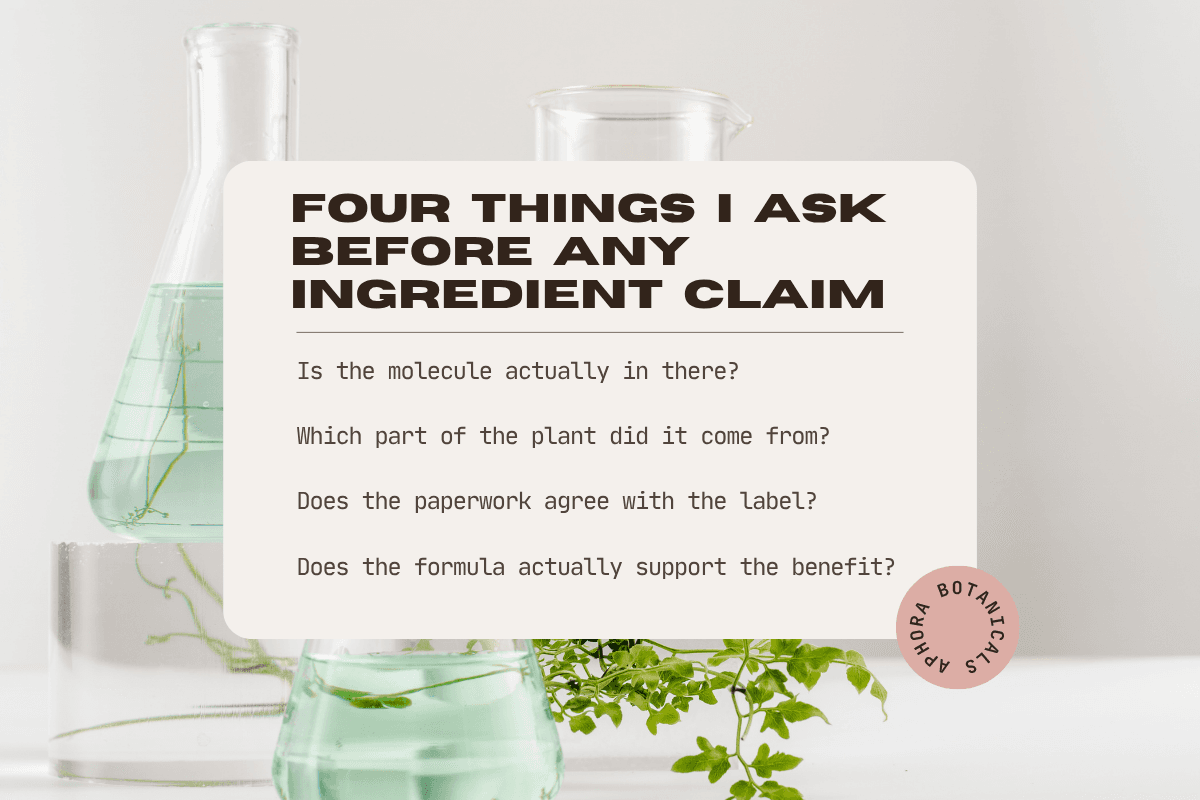
Four Questions I Ask Before Any Ingredient Claim
The test a formulator runs before a word reaches a label — and how to run it on anyone, including me.
There is a particular kind of sentence that gets written about skincare ingredients, and once you can see it you cannot stop seeing it.
Rich in antioxidants. Clinically proven to boost collagen. Contains ceramides.
Each one is doing a job, and the job is not accuracy. They are written to be reassuring, they are rarely checked, and almost nobody — including the person writing them — stops to ask whether the sentence survives contact with the ingredient list.
I write my own copy and I formulate my own products, which means there is nobody between me and that temptation. So I built four questions, and nothing goes on a label or a page until it has been through all of them.
They are not complicated. You can use them on anyone’s products, including mine.
Question One
Is the molecule actually in there?
This sounds too obvious to be a real test. It is the one that catches the most.
Contains ceramides is the clearest example in the whole category. Ceramides are the lipid everybody has now heard of, the one every barrier product leads with, and the word has drifted loose from the molecule. Plenty of products carrying it contain a token quantity; some contain something ceramide-adjacent; the claim rarely tells you which.
Aphora contains no ceramide. What is in my formulas are botanical lipids that behave the way ceramides behave inside the barrier’s structure — olive squalane, camellia, prickly pear, murumuru. The right chain lengths, the right balance of plant sterols and fatty acids, molecules that settle into the spaces between skin cells and hold the arrangement together.
So the sentence I use is ceramide-like botanical lipids. Three extra words. They are the difference between a claim that survives the ingredient list and one that does not.
There is a deeper reason the shorter claim is weak, and it is worth knowing whoever makes your moisturizer. The barrier’s mortar is not one lipid but three — ceramides at roughly half by mass, cholesterol at a quarter, fatty acids at around fifteen percent — and what makes it work is the proportion. Research on barrier repair found that supplying only two of the three could leave skin healing more slowly than applying nothing at all.
Which means contains ceramides is not only a claim that often outruns the formula. It is answering a question the barrier does not ask.
Question Two
Which part of the plant did it come from?
This is the question I would hand to anyone reading an ingredient story anywhere, because most of the distance between what a botanical promises and what it delivers lives inside it.
Seed, leaf, bark, resin, heartwood, flower. These are different materials with different chemistry, and the name on the label covers all of them equally. Sandalwood tells you the tree. It does not tell you what you have.
Sandalwood is the clearest case I know. The genuinely remarkable molecule in that tree is ximenynic acid — an eighteen-carbon fatty acid carrying both a double bond and a triple bond. Carbon–carbon triple bonds are rare in natural fats, and this one appears to act on microcirculation: blood flow, rather than hydration or collagen. In Australian sandalwood nut oil it makes up over a third of the total fat.
The nut. Almost every sandalwood used in skincare is a heartwood distillate — the volatile fraction, steam-carried out of the timber, where that fatty acid is absent entirely. Same tree. Two materials with almost nothing in common.
I have my materials analyzed, so I know which one is in my bottle. Mine is the heartwood, which means microcirculation is not a claim available to me, and I do not make it.
What the analysis does show is close to ten percent bisabolol — the molecule chamomile is known for, one of the gentlest and best-studied calming actives in botanical skincare. That is the claim the material supports, and it is the one I make.
A laboratory measuring it is a different order of evidence from a paper mentioning it.
Question Three
Does the paperwork agree with the label?
Every raw material arrives with a certificate of analysis: what the laboratory found, in what proportion. Every finished product carries an ingredient list. Most of the time these agree, and nobody looks.
When they disagree, the certificate is the fact and the list is the error. Not the other way round, however long the list has been published. An ingredient list is not marketing — it is the statement of what is actually in the jar — and copy written off a list that no document supports is how a brand ends up believing its own paperwork.
I apply that rule to my own pages. My moisturizer’s sandalwood is Santalum spicatum — Australian, harvested under one of the most tightly regulated programs in the world. Not Santalum album, the Indian species whose demand made sandalwood a conservation problem and which is trade-restricted for that reason. The ingredient list says what the analysis says.
These two species sit under the same word on most labels you will read. They are not interchangeable, and which one a brand uses is a real decision with real consequences upstream of you.
Question Four
Does the formula actually support the benefit?
The last question is the one that costs something, because it is the one that removes words you would like to use.
A benefit claim needs an ingredient with a plausible route to the thing it claims to affect. Firmness lives in the dermis — the living layer, below the one your products mostly reach. Claiming it requires something that gets there and does something when it arrives.
My eye treatment does not contain anything of the kind. No peptide, no retinoid alternative, nothing with a credible path to the dermis. It is aloe, lipids, humectants, soothers and an antioxidant — an excellent formula for the thinnest skin on the face, and not a firming one.
So it is a barrier concentrate, and the three words on it are hydrate, smooth, calm. Calm is what the allantoin, oat beta-glucan and aloe genuinely do.
The same test governs how I describe a preservative. The trace of salicylic acid in that formula is there to keep the product safe. Salicylic acid does occur in willow bark, and benzyl alcohol does occur in jasmine — both true, and both beside the point, because the cosmetic grades are synthesized rather than extracted, as they are in essentially every product you own. Writing the botanical origin next to my ingredient would make a claim the sentence never literally makes. So I say what they are and where they actually come from.
What the four questions are really for
None of this makes a product better. The formula is the formula whether the copy is accurate or not.
What it does is make the claim worth something. If I tell you a material is in there, it is in there. If I tell you it does something, the formula supports it. If I say nothing about a mechanism I find genuinely fascinating, it is because the evidence did not reach my bottle.
I have changed wording on my own pages because of these questions, and I expect to again. That is what a standard is for.
And they work on anyone. Ask which part of the plant. Ask whether the molecule is on the list. Ask whether the benefit has anything in the formula to stand on.
I would rather you asked those of me than took my word.
About the Author
Fay
Founder and formulator of Aphora Botanicals. The Aphora range — TERRA GLOW skincare, the Aromatherapy collection, and the Rich Body Butters — is composed to her standards in Marin, California.